
Blog

  • Chatbot WooCommerce: The 2026 Guide for Small Online Stores

    Chatbot WooCommerce: The 2026 Guide for Small Online Stores

    chatbot woocommerce for small business

    For most teams, the chatbot woocommerce shortlist starts with support volume. If you run a WooCommerce store, a chatbot can answer customer questions, suggest products, and take pressure off your inbox. The most affordable option in 2026 is YakWP, which is free on any number of sites and only costs EUR 64 for a lifetime Pro license. This guide walks through what a chatbot for WooCommerce does, how to pick one, and what it really costs.

    What Does a Chatbot WooCommerce Plugin Actually Do?

    Pricing matters more than feature lists across chatbot woocommerce. A chatbot for WooCommerce sits on your site and talks to visitors in real time. It can answer questions like “Where is my order?” or “Do you have this in size 10?” without you lifting a finger. The bot reads your product pages, your FAQ, and your policies, then gives a plain answer using your own words.

    Setup effort is the hidden cost in any chatbot woocommerce decision. The key is that it uses your store’s content, not generic internet knowledge. So if you sell handmade candles and someone asks about shipping to Canada, the bot checks your shipping page and replies with your exact policy. That is the difference between a toy and a real sales assistant.

    Data ownership decides it for regulated teams weighing chatbot woocommerce. Most WooCommerce chatbot plugins also capture leads. If a visitor asks a question the bot cannot answer, it can collect their email and let you follow up later. That turns a casual browser into a potential customer.

    Chatbot WooCommerce: How Much Does a WooCommerce Chatbot Cost in 2026?

    Response quality, not raw speed, separates chatbot woocommerce in practice. Prices vary wildly, and the cheapest option is not always obvious. Here is a straight comparison of the main players, using verified pricing from their own sites.

    Tool Free Plan Paid Plan Starts At What You Get
    YakWP $0, no site limit EUR 64 one-time (Pro) Full chatbot, BYOK, lifetime updates on Pro
    Tidio $0, 50 conversations/mo $24.17/mo billed yearly 100 billable conversations, AI extras limited
    Intercom From $0.99 per AI outcome $99/mo Pro add-on Per-resolution pricing, plus seat fees
    Chatbase $0, 50 message credits/mo $40/mo 700 message credits, agents deleted if idle
    ChatBot.com No free plan $19 per user/mo 1 AI agent, 10 AI resolutions

    Notice the pattern. Most tools charge a monthly fee that grows as you get more conversations. YakWP is different because the free tier has no site limit and the Pro version is a one-time payment. For a small store, that can save hundreds of euros per year.

    Chatbot WooCommerce: Why “Bring Your Own Key” Matters for WooCommerce

    YakWP uses a model called BYOK, which means Bring Your Own Key. You sign up for a free or paid account with a model provider like Google Gemini, OpenAI, or OpenRouter, then paste your key into the plugin. The chatbot then uses that provider to generate answers.

    This matters for two reasons. First, cost. Google’s free Gemini tier gives you 500 requests per day, which is plenty for a small bakery or a consultant. If you outgrow that, you pay the provider directly, not a middleman markup. Second, privacy. The conversation transcript and your product index stay in your own WordPress database. Only the prompt itself goes to the provider you chose.

    So your customer’s chat history lives on your server, not on a third party’s cloud. That is a big deal for stores that handle personal data or just do not want to share everything with a SaaS company. You can read more about why BYOK and data ownership matter.

    Chatbot WooCommerce: Can a WooCommerce Chatbot Increase Sales?

    Yes, but not by magic. A chatbot helps in three concrete ways. First, it answers pre-sale questions instantly, so a visitor does not abandon the cart because they could not find the size chart. Second, it recommends products based on what the customer describes. Say a customer runs a two person cleaning company and wants eco friendly supplies. The bot can point them to the right category.

    Third, it catches after-hours traffic. If someone visits at 11pm and asks about delivery times, the bot gives an answer right away. That person might otherwise leave and buy from a competitor the next morning. T

    chatbot woocommerce - What Does a Chatbot WooCommerce Plugin Actually Do?

    he bot does not close every sale, but it removes friction from the buying process.

    One caution: the bot is only as good as your content. If your product descriptions are thin, the bot will struggle. Spend an hour writing clear answers to the top 20 questions you get, and the bot will handle most of those on its own.

    How Do You Set Up a Chatbot for WooCommerce Fast?

    Setup takes about five minutes with YakWP. You install the plugin, create an account with a model provider, and paste your API key. Then you tell the bot which pages to read, like your shop page, your FAQ, and your shipping policy. The plugin indexes that content so the bot can search it later.

    The bot uses something called semantic search, which means it understands meaning, not just keywords. If a customer types “when will my order arrive,” the bot knows that relates to your shipping page even if the exact words do not match. You can see how the bot finds answers in more detail.

    After that, you place a chat widget on your site and test it with a few real questions. Most store owners tweak the tone of the answers in the first week. The full walkthrough is in this five minute setup guide.

    Free vs Pro: What Do You Actually Miss?

    The free tier of YakWP is not a crippled demo. It ships the full chatbot feature set, works on unlimited sites, and keeps conversations with retention. The only limits are that it shows a small “Powered by Yak” credit, and you cannot export conversations as CSV.

    Pro removes that credit, which is called white-label, and adds custom widget CSS so you can match the chat bubble to your brand colors. Pro also adds CSV export, which is handy if you want to review chats in a spreadsheet, and priority support if something breaks. The one-time price is EUR 64 for a single site license, with volume options if you manage multiple stores.

    For most small shops, the free tier is enough for months. Upgrade when you want the credit gone or you need the export. The free vs Pro breakdown covers every difference in plain language.

    Which WooCommerce Chatbot Is Best for a Small Budget?

    If your budget is zero, YakWP wins because the free tier has no site limit and no monthly cap on conversations. Tidio‘s free plan stops at 50 billable conversations per month, and Chatbase deletes your agents after 14 days of inactivity. Those are real constraints.

    If you are willing to pay monthly, ChatBot.com starts at $19 per user per month for one AI agent and 10 AI resolutions. That is fine for a tiny store, but it scales fast. Intercom charges per outcome, which can be unpredictable if you get a busy month.

    The honest advice is to start free. Install YakWP, connect a free Gemini key, and see if the bot handles your top questions. If it does, you have saved yourself a monthly bill. If you need more, the Pro upgrade is a one-time EUR 64, not a recurring fee. Compar

    chatbot woocommerce - How Much Does a WooCommerce Chatbot Cost in 2026?

    e that to $24.17 a month for Tidio, and the math is clear for a small operation.

    What About the Big Names Like ManyChat?

    ManyChat is popular for social media messaging, especially Instagram and Facebook. Its Pro tier starts around $15 per month, but that price is not verified on their site and can change. ManyChat is not built for WooCommerce product questions the way a dedicated chatbot plugin is. It is better for broadcast campaigns and simple flows.

    If you want a bot that reads your product catalog and answers specific order questions, a WooCommerce focused plugin is a better fit. ManyChat can be a complement, but not a replacement, for on-site chat.

    Chatbot WooCommerce: How to Choose the Best One

    Start with the workflow you want to automate, then shortlist chatbot woocommerce that connect to it without middleware. The chatbot woocommerce that look best in a demo are not always the ones your team keeps using after the first month.

    Score each option against three numbers: cost per resolved conversation, hours of setup, and who owns the conversation data. Those three numbers eliminate most of the chatbot woocommerce on a long list far faster than a feature matrix will.

    To summarise, the chatbot woocommerce that fit your team are the ones you can operate without a dedicated engineer. Pick from the chatbot woocommerce above by matching one constraint first: budget, data ownership, or setup time. Whichever of the chatbot woocommerce you choose, budget an afternoon for testing real conversations before committing. Revisit your chatbot woocommerce shortlist every quarter, since pricing and model line-ups on this list change often.

    Chatbot WooCommerce: What to Check Before You Install One

    Most of the chatbot woocommerce shortlist on this page will answer questions. Fewer of them will help a shopper find the product they actually came for, and that is where a store earns its money. Before you install anything, check four things against your own store.

    1. Does it read your catalog, or only your pages? A general website chatbot knows the pages you point it at. A store assistant also needs product titles, prices, stock status and categories. If you want shoppers to search in plain language instead of guessing keywords in your theme’s search box, the WooCommerce search integration is the part worth testing first — ask it for “a waterproof jacket under 100 euros” and see what comes back. That one test separates a chatbot woocommerce plugin that helps shoppers from one that only deflects them.

    2. Does the setup fit into an afternoon? Install the plugin, connect a model API key, index your shop pages, then test with questions your customers really ask. If a tool needs a developer or a paid onboarding call before it says anything useful, it is the wrong tool for a small store.

    3. Can you start at zero cost? YakWP is free on any number of WooCommerce stores; your own Gemini, OpenAI or OpenRouter key covers model usage. You pay once only if you later want white-label branding, CSV export or priority support.

    4. What happens when the bot does not know? The correct behaviour is to say so and offer a handoff — an email capture or a contact link. A chatbot that invents a shipping time or a stock level costs you a customer, and you usually hear about it in a review rather than a support ticket. Test that failure path once, on the chatbot woocommerce option you are actually considering, before you commit.

    Frequently Asked Questions

    Can a WooCommerce chatbot replace customer support?

    Not entirely, but it can handle the repetitive 80 percent. Order status, shipping times, return policies, and product specs are all fair game. When the bot hits a question it cannot answer, it should hand off to a human or collect an email. That reduces your workload without losing the personal touch.

    How does a WooCommerce chatbot know about my products?

    You point it at your product pages and other content, and it indexes that text. When a customer asks a question, the bot searches that index using semantic search to find the most relevant answer. It does not guess from general knowledge.

    Is my customer chat data private?

    With a self-hosted plugin like YakWP, the transcript and your content index stay in your WordPress database. The prompt is sent to the model provider you choose, like Google or OpenAI. So the data is not fully local, but it is not stored on a random SaaS platform either. You control the provider.

    What if I have more than one WooCommerce store?

    The free tier of YakWP works on any number of sites, so you can test it everywhere for $0. Pro is per site, but volume licenses cover 3, 5, 10, or 30 sites at a discount. The 3 site license is EUR 129, which is cheaper than buying three single licenses.

    Do I need to be technical to set this up?

    No. If you can install a WordPress plugin and copy paste a key, you can do it. The hardest part is choosing a model provider, and the free Gemini tier is a good start. The free Gemini tier limits are explained in plain terms.

    Does a WooCommerce chatbot help shoppers find products?

    It can, but only when it is connected to your catalog rather than just your pages. A product-aware assistant lets a shopper describe what they need in their own words and returns matching items with current prices and stock. That is a different job from answering policy questions, which is why the setup step matters: index the products, get the currency right, and test with the phrases customers actually type. A chatbot woocommerce setup that cannot answer a sizing or stock question will not earn its place.

    How long does it take to set up a WooCommerce chatbot?

    For a self-hosted plugin with your own model key, an afternoon is realistic: install it, connect the provider, let it index your store pages, then test. Hosted services switch on faster but add a monthly bill and keep the conversations on their servers. Budget extra time for testing either way — the first week of real questions tells you whether your store content is complete enough for the bot to answer well.

    Where Do You Go From Here?

    A chatbot for WooCommerce is not a luxury anymore. It is a practical way to answer questions at any hour, recommend products, and capture leads without hiring extra staff. The cost of entry is zero with YakWP, and the Pro upgrade is a one-time payment that will not creep up on your monthly bills.

    Start with the free plugin, connect a free Gemini key, and let it index your shop pages. Test it with the questions your customers actually ask. If it works, you have saved yourself hours of repetitive replies. If you want the branding removed or CSV export later, the Pro upgrade is there when you are ready. The best time to add a chatbot to your WooCommerce store was yesterday. The second best time is right now.


    Get YakWP free and see what it costs to upgrade.

  • A Chatbot for WooCommerce With Built-in Search — YakWP 2.5.0

    A Chatbot for WooCommerce With Built-in Search — YakWP 2.5.0

    ▶ Listen to this article

    The Cost of a “No Results Found” Screen

    Picture a visitor on your WooCommerce site. They are looking for a specific item, maybe a “waterproof hiking boot,” but they type “hikin bot for watter” into your search bar. Your standard WordPress search engine stares back at them with a blank screen or a message saying, “No products found.” In that moment, you lose a customer. They assume you don’t stock the item, hit the back button, and go to Amazon or a competitor. This happens thousands of times a day across the web because traditional search engines are literalists; they require an exact match between a user’s string of characters and your database entries. If the spelling is off, or the synonym doesn’t match your product title, the bridge between your stock and your customer collapses.

    This is where YakWP 2.5.0 shifts the strategy from simple keyword matching to semantic understanding. Semantic search compares the meaning of a query against your content instead of demanding a literal word-for-word match. You no longer need to hope your customers use the exact vocabulary found in your product descriptions. By installing the plugin from the official YakWP download page, you have a free chatbot for woocommerce that is also a search engine; after a quick install you gain access to a search experience that understands intent, handles typos, and parses natural language questions directly within your WooCommerce environment.

    How Semantic Search Fixes the Intent Gap

    The core of the issue with standard WooCommerce search is the lack of context. When a visitor asks, “How much are your heavy-duty winter gloves?”, they aren’t typing the product SKU or the official catalog name. They are asking a question. Traditional search bars will look for the exact phrase “How much are your heavy-duty winter gloves” and find nothing, because that sentence isn’t the title of a product page. Semantic search, which is now free in YakWP 2.5.0, changes the game by using vector embeddings to map meaning.

    When you click “Build Index” in the YakWP dashboard, the plugin processes your published posts, pages, and products into a numerical vector format. This isn’t just about keywords; it’s about the concept behind the content. When that same visitor types their question, the AI calculates the distance between the meaning of their query and your indexed content. It realizes that “how much are” relates to the price field of your products and that “heavy-duty winter gloves” maps to your product page for “Pro-Grade Thermal Mitts.” The result? It serves the right page, even if the phrasing is completely different.

    A shopper using the YakWP chatbot for woocommerce search on a laptop
    A keyword box returns nothing for a near-miss. A semantic search box still finds the product.

    Installation and Configuration: Putting Search in Your Menu

    You don’t need a developer to replace your ineffective search bar. Once the plugin is active, you have two primary ways to deploy the YakWP search experience. First, you can use the shortcode

    and drop it into any page, post, or widget area. This is ideal if you want to create a dedicated “Ask our Shop” page that combines your chatbot with a high-powered search interface.

    For a sitewide solution, you can simply tick the “Search box in navigation menu” option in the YakWP settings. This automatically injects a smart search box into your theme’s header. It immediately overrides the limitations of the default WordPress loop. Because this feature is built into the plugin, you aren’t paying extra for a third-party site-search service that scrapes your site and sends data to an external server. Everything stays on your WordPress site, and you control the index via the “Build Index” button that triggers whenever you update your catalog.

    Handling Typos and “Did You Mean?” Logic

    One of the most frustrating aspects of online shopping is the “typo tax.” If a user types “camera lense” instead of “camera lens,” most stores will treat that as a null search. YakWP handles this by utilizing the AI models you connect via your API key. Whether you are using Google Gemini, OpenAI, or the wide range of OpenRouter models available in the plugin, the AI is capable of performing fuzzy logic correction. It recognizes the intent behind the misspelling and can prompt the user with “Did you mean?” suggestions, or simply display the semantically relevant results despite the typo.

    This functionality is included in the free version of the plugin. As long as you keep the “Powered by Yak” link in the footer, you have full access to these semantic search capabilities. If you move to the Pro version for a one-time fee of EUR 64, you gain the ability to remove that branding, which is often preferred by stores that want a fully white-labeled experience. Regardless of the version, the underlying vector search technology remains the same robust tool for connecting visitors to products.

    Online store search results shown on a laptop
    Live product prices in the results are pulled straight from your catalog.

    Optimizing for Your API Usage

    A common concern when adding AI-powered search is the cost of API calls. YakWP 2.5.0 addresses this with intelligent caching and rate limiting. Every search query made by a visitor is compared against a cache of identical queries. If ten customers search for the same “waterproof boots” query in one hour, the AI only processes the query once; the subsequent visitors receive the cached result instantly. This dramatically reduces the number of API credits consumed, making it feasible to run on even the most generous free tiers of models like Google Gemini.

    The plugin also includes built-in rate limiting to prevent bots or bad actors from scraping your search index or burning through your API quota. You can configure these limits to ensure that legitimate human visitors always have access to the search bar while automated threats are blocked. This balance of power and efficiency is what makes the YakWP search implementation different from external, cloud-based search plugins that often charge monthly subscription fees based on search volume.

    From Keyword Matching to a Smarter Chatbot for WooCommerce

    The real transformation for a WooCommerce store happens when you stop thinking of “search” and “chatbot” as two separate entities. With YakWP, the chatbot is the search engine. When a customer opens the widget to ask, “Do you have any discounts on bulk orders?”, the plugin doesn’t just search your blog posts for the word “discount.” It performs a semantic search across your entire site content, including your policy pages and product descriptions. It finds the relevant information – perhaps your wholesale page – and presents it directly in the chat window.

    If the user is logged in or provides their email during a lead-capture interaction, the plugin captures this intent. Because it integrates with webhooks, you can automatically send these interaction logs to platforms like n8n, Zapier, or Make. You aren’t just giving the user an answer; you are building a profile of what your customers are actually looking for, which is often very different from what you think they are looking for.

    The Four Modes of Engagement

    To make the search and chat experience work for your specific business model, YakWP offers four distinct modes of operation:

    • Sales Mode: The AI focuses on product recommendations and highlighting value propositions to convert the visitor into a buyer.
    • Support Mode: The AI prioritizes retrieving technical documentation, order status info, and troubleshooting guides from your posts and pages.
    • Explain Mode: The AI acts as an educator, perfect for stores selling complex or technical products that require an explanation of use-cases.
    • Custom Mode: You define the system prompt, allowing you to fine-tune the AI’s personality and the specific constraints of your brand voice.

    By switching between these modes, you can ensure that the search results generated by your visitors aren’t just accurate – they are tailored to the tone of your business. A tech-heavy hardware store might want the precision of Support Mode, while a boutique clothing store might prefer the conversational, Sales-driven tone of the Sales Mode.

    Integrating with Your Existing Workflow

    Updating your search index is a one-click process. When you add a new collection of products to your WooCommerce store, you simply return to the YakWP settings and click “Build Index.” The plugin crawls your site, creates the vector representation of your new content, and ensures the search engine is up to date. You don’t have to manually tag products or manage complex synonym lists. The AI handles the heavy lifting of understanding how your new product descriptions relate to the queries your customers are already typing.

    This integration is entirely local. Unlike third-party search tools that require you to upload your product catalog to their servers, YakWP keeps your data within your WordPress database. This is a critical distinction for store owners concerned about data privacy and the integrity of their product information. You remain the sole owner of your data, and your search functionality isn’t dependent on the uptime or the changing pricing models of a third-party SaaS provider.

    FAQ

    Does the free version of YakWP include the semantic search feature?

    Yes. Semantic (vector) search is included in the free version of the plugin as of version 2.3.0. You get full access to the AI-powered search, the ability to index your posts and products, and the search box shortcode. The only requirement for the free version is that you keep the “Powered by Yak” branding link in the footer.

    How does the search handle live pricing if I update my product prices?

    When you update a product price in WooCommerce, the change is reflected immediately because YakWP pulls directly from your database. The semantic index identifies the product entity, and when a user asks about price, the AI generates a response based on the current data in your shop, not a static snapshot. For the best accuracy, ensure your product pages are clearly formatted with price information.

    Can I use my own API key to avoid monthly subscription fees?

    Absolutely. YakWP is designed for you to bring your own API key. You can use free tiers from providers like Google Gemini (which offers up to 500 requests per day) or free models via OpenRouter. This puts you in full control of your costs, rather than being forced into a tiered subscription model by a plugin provider.

    What happens if the semantic search doesn’t find a result?

    If the AI’s semantic search cannot find a high-confidence match for a query, the plugin automatically falls back to a standard keyword search. This ensures that even in the unlikely event the AI is unsure, your visitor still gets the most relevant results possible based on traditional database matching, preventing that dreaded “No Results Found” error screen.

  • Command Code Pricing Review: Plans, Limits, Credit Value (2026)

    Command Code Pricing Review: Plans, Limits, Credit Value (2026)

    ▶ Listen to this article

    Command Code is the agentic coding platform from commandcode.ai — a CLI and Studio toolset that wraps Anthropic, OpenAI, Google, MiniMax, DeepSeek and dozens of open-weight models behind one interface. Its pricing model is the most interesting part of the product: flat monthly subscription with a MASSIVE credit multiplier, rolling usage windows, and credits that never expire. This is my honest command code pricing review after reading the full pricing and limits documentation cover to cover.

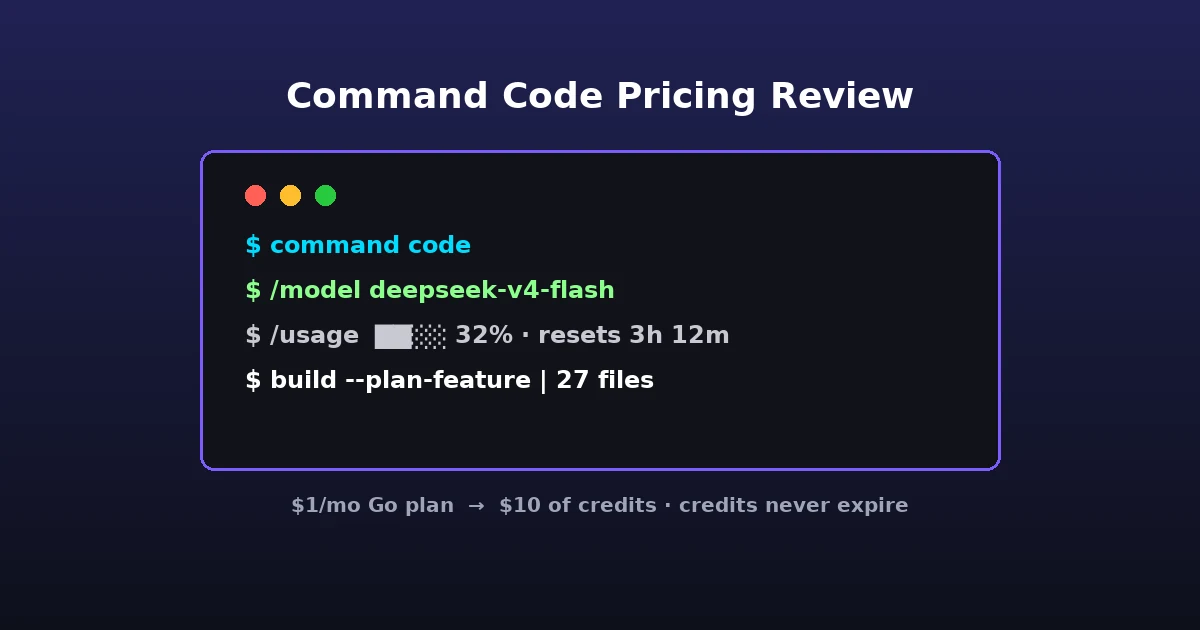
    command code pricing review hero

    What Is Command Code?

    Command Code is an AI coding agent that runs in your terminal (CLI) and in a desktop Studio plus IDE integrations. You bring your own project, Command Code reads your codebase, and lets you plan, write, review and fix code using the model you pick. It is not a chatbot website widget — it is a developer tool aiming to replace the paid tiers of Anthropic and OpenAI coding planes with a subscription that bundles access to many models at once.

    The key architectural choice: instead of a fixed monthly model fee, Command Code sells you a credit pool at a steep multiplier. You then spend those credits per token, per model, at the model’s own API rate. This is the same “buy a pool, spend by model” structure as OpenRouter, but wrapped in a flat monthly plan where the credits are heavily subsidized.

    Command Code Pricing: The Plans at a Glance

    The documentation on the Command Code pricing and limits page lists six individual plans and two team plans. Here is the real table from the doc:

    PlanPrice/moCredits/moApprox requests5-hour limitWeekly limit
    Go$1$10~9K$2$5
    GOAT$10$70~75K$14$35
    Pro$20$80~100K$16$40
    Provider$15Pay-as-you-go———
    Max 10×$100$150~230K$45$90
    Max 20×$200$300~370K$90$180
    Team Pro$40~35K requests—$12$24
    Enterprise$5,000+CustomCustom——
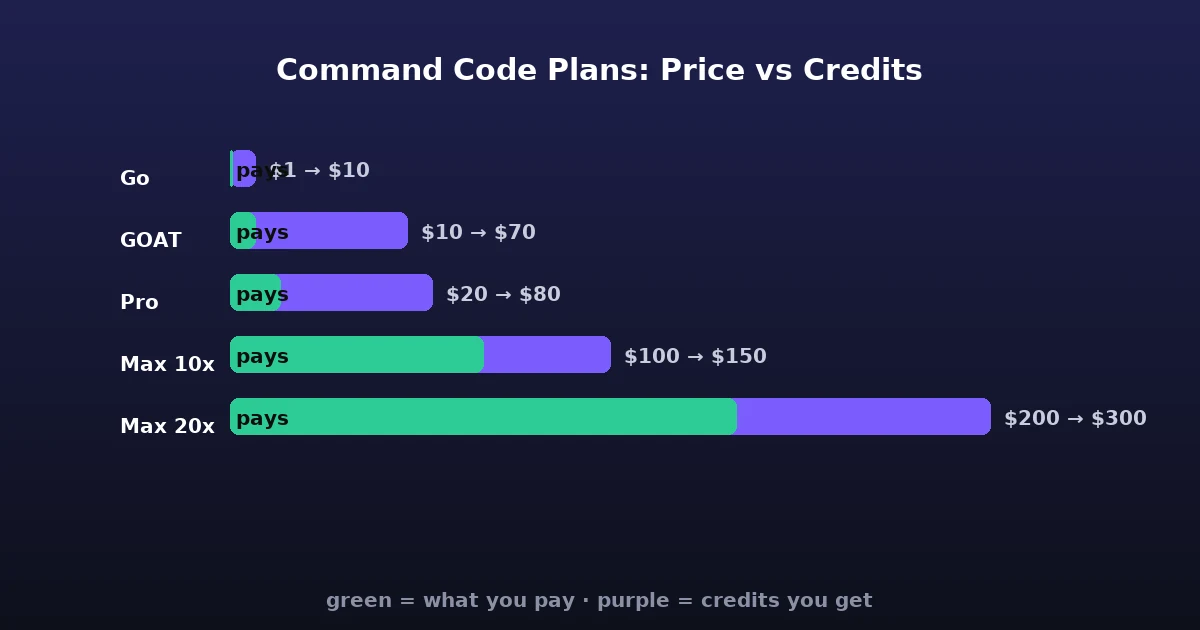
    command code pricing plans price vs credits

    How the Credit Multiplier Actually Works

    This is the single most surprising thing about command code pricing. On the Go plan you pay $1 and get $10 of credits. On GOAT you pay $10 and get $70. On Pro $20 for $80. Max 10× is $100 for $150, Max 20× $200 for $300. That is a 10× to 1.5× credit bonus depending on tier.

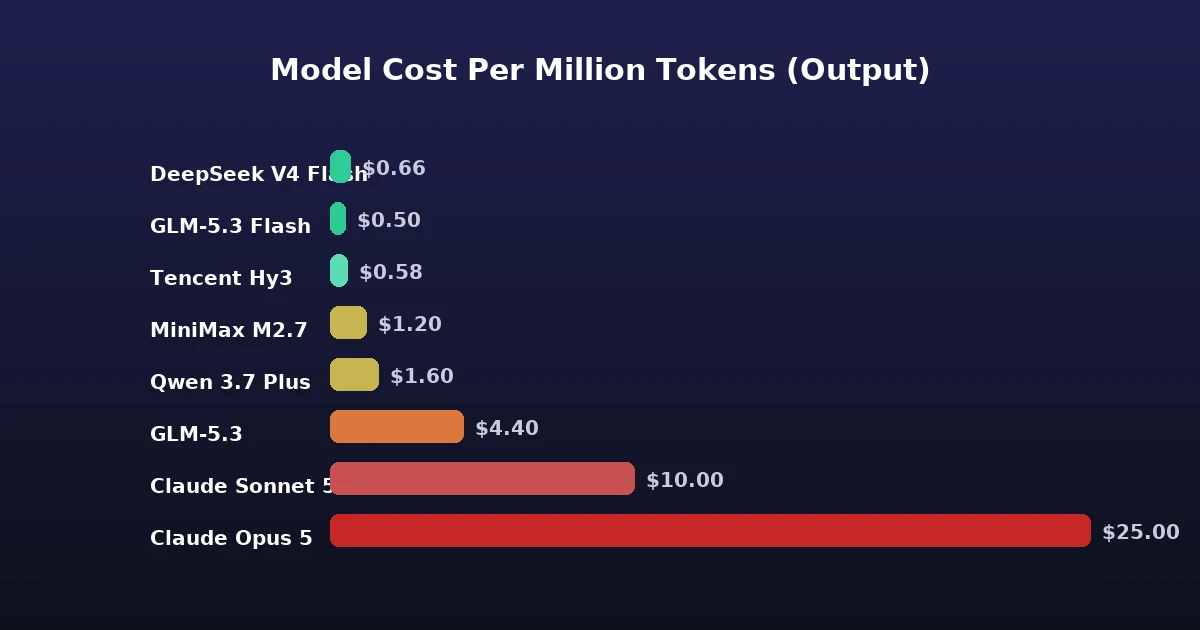
    The credits are then spent at the model’s own per-token API rate. A cheap model like DeepSeek V4 Flash at $0.15 input / $0.60 output per million tokens (off-peak) stretches much further than Claude Opus 5 at $5.00 / $25.00. Command Code’s own estimate: on Go, DeepSeek V4 Flash runs about 25,000 requests with no cache, or ~15,000 once the typical 50K of cache reads are counted.

    Rolling Usage Windows: The Hidden Constraint

    Every subscription plan has two rolling limits on top of the monthly credit pool: a 5-hour window and a weekly window. They are designed to stop a single burst from draining a whole month in one afternoon.

    Here is the tradeoff you need to understand before buying: your monthly credits are not immediately spendable all at once. On Go, the 5-hour window caps you at $2 of usage and the weekly window at $5 of your $10 pool. On Max 10× you can spend $45 in 5 hours and $90 a week out of $150. Windows roll from first use, not on a fixed clock, and reset each window-length.

    The good news: on-demand top-up credits are exempt from the rolling windows. If you hit a window mid-session you can buy extra credits and keep working immediately, with the window check skipped entirely.

    Do Credits Really Never Expire?

    Yes — that is stated plainly. Monthly subscription credits reset at the start of each billing cycle, but top-up and on-demand credits roll over forever. They are not throttled, not capped, and you can buy them at model cost. This is genuinely consumer-friendly for a pay-per-usage product and a real differentiator versus many competing plans that expire credits monthly.

    Model Pricing: The Depth of the Catalog

    Command Code’s catalog is deep. Across all plans the docs list 89 models at the time of writing, with 7 deals and 5 free models. The newest head is Claude Opus 5.5 at $4.00/$20.00 per million tokens — cheaper than Claude Opus 5 — alongside GPT-6 Sol and the budget GPT-6 Luna, and MiMo V2.6 Pro and Flash. Here is what matters for real coding work:

    Premium frontier models

    ModelInput/MOutput/MCache read/MCache write/M
    Claude Opus 5$5.00$25.00$0.50$6.25
    Claude Sonnet 5$2.00$10.00$0.20$2.50
    Claude Haiku 4.5$1.00$5.00$0.10$1.25
    GPT-5.6 Sol$5.00$30.00$0.50$6.25
    Claude Opus 5.5 (1M ctx)$4.00$20.00$0.20$5.00
    GPT-6 Sol (1.1M ctx)$2.00$10.00$0.20$2.50

    Cost-efficient workhorses

    ModelInput/MOutput/MCache read/M
    DeepSeek V4 Flash (off-peak)$0.15$0.60$0.003
    DeepSeek V4.1 Flash$0.15$0.60$0.003
    DeepSeek V4 Pro (off-peak)$0.66$1.98$0.022
    GLM-5.3 Flash$0.15$0.50$0.03
    MiniMax M2.7$0.30$1.20$0.06
    Qwen 3.7 Plus$0.40$1.60$0.08
    Tencent Hy3$0.14$0.58$0.035
    MiMo V2.6 Flash$0.14$0.28$0.0028
    MiMo V2.6 Pro$0.435$0.87$0.0036
    GPT-6 Luna (1.1M ctx)$0.10$0.50$0.01
    command code pricing model costs per million tokens

    Free Models in 2026: Real Zero-Cost Coding

    At the time of writing, Command Code had five free models — some permanently, some time-bound. (LongCat 2.0, free when this review was first written, has since moved to a standard per-token rate, which is a good reminder that this roster rotates.)

    • Space Bunny Alpha — free while the stealth preview lasts (1M context, input/output/cache all $0.00). It is a stealth model: an anonymous third-party provider runs it, may retain prompts and completions, and offers no zero-data-retention guarantee — so it is deliberately excluded when you run with CMD_ZDR=1.
    • Ling 3.1 Flash — free while it lasts, with no daily request limit (262K context, input/output/cache all $0.00). It is inclusionAI’s hybrid reasoning model, aimed at coding and multi-step work.
    • Laguna S 2.1 — free while capacity lasts, available on all plans (input, output and cache reads all $0.00).
    • Ling 3.0 Flash — free while capacity lasts (256K context).
    • Ling 3.0 Flash Sante — free while it lasts, up to 100 requests a day (262K context, health-and-medicine tuned).

    One caveat worth knowing before you rely on the free lanes: the free variants are served by third-party hosts (e.g. Novita for Ling 3.0 Flash Sante, which carries a 100-requests-per-day cap) that offer neither zero-data-retention nor a no-training guarantee, and Space Bunny Alpha is served by an anonymous stealth provider that may keep prompts. If you run with CMD_ZDR=1 to force zero retention, you cannot use those free lanes at all. The free models are limited-capacity offers, so treat them as a nice bonus, not a dependable base.

    Active Deals That Change the Math

    The docs flag seven deals live at the time of writing that can stretch your credits dramatically:

    • kimi-k3 boosted credits — $60 of usage on GOAT (up from $20) and $70 on Pro (up from $30), through October 7, 2026.
    • glm-5.3-flash boosted credits — $10 on Go, $60 on GOAT and $70 on Pro, while capacity lasts.
    • minimax-m3 at 2× usage — every credit goes twice as far.
    • mimo-v2.5 and mimo-v2.5-pro up to 99% off.
    • stealth/space-bunny-alpha, laguna-s-2.1-free, ling-3.0-flash-sante:free and ling-3.1-flash-free are free — requests on those four lanes cost no credits at all and do not draw down your usage windows (see the free-model caveats above).
    • deepseek-v4.1-flash boosted credits, now with no end date — $10 of this model on Go, $60 on GOAT and $70 on Pro. The doc has made the boost permanent and it applies automatically.

    Deals stack with your plan’s credit bonus. On GOAT and Pro the deals are baked into per-model allowances automatically, with nothing to enable. On top-up credits the same discount applies when spent on the discounted model. The real-time Usage page shows the discounted per-request price as it happens, and deals auto-expire with no action needed.

    Enterprise and Security

    For organizations, Command Code offers an Enterprise tier from $5,000+/mo with custom model pools, SLAs and dedicated support on your own infrastructure. The documented security posture is strong for a coding agent: Command Code does not train on your code and does not store your code snippets unless you choose to share them. Taste data (your personalization) is stored locally in your project directory. Commercial model traffic is sent to the provider’s API (Anthropic, OpenAI, Google, Azure) and handled per their privacy policy, with EU hosting on demand. There is a Zero Data Retention mode available, subject to the free-lane caveat above.

    How Command Code Compares to Other Providers

    If you already use OpenRouter or Google AI Studio’s free tier, Command Code is a different category. OpenRouter is a pure API gateway: you pay per token with no subscription bonus. Google AI Studio gives you a limited free tier. Command Code bundles a subscription plus access to both open-weight and premium models, with the credit multiplier as the main incentive. The closest analogues are the paid coding plans of Anthropic and OpenAI, but Command Code’s advantage is model choice and the never-expiring top-up credits.

    For a website owner or chatbot operator rather than a developer, Command Code is not the tool for adding a chatbot to WordPress — that is a code-heavy workflow. But if you are building, deploying or maintaining that chatbot’s backend, plugins, or n8n workflows, a cheap Go plan gives you a serious coding agent for a dollar a month.

    Who Should Buy Which Command Code Plan

    • Go ($1/mo, $10 credits) — hobbyists, light script editors, first try. Enough for dozens of small tasks and a real test of the workflow.
    • GOAT ($10/mo, $70 credits) — the best value if your work is mixed open-weight coding. ~75K requests.
    • Pro ($20/mo, $80 credits) — heavy users who want premium models like Sonnet 5 and GPT-5.6 in the mix. ~100K requests.
    • Max 10×/20× ($100/$200) — professional teams hammering code all day; the credit multiplier is weakest here (1.5×) but the pool is biggest and windows are generous.
    • Provider API ($15) — pay-as-you-go raw API access, no subscription, for integration into your own apps.

    Limitations and Honest Caveats

    • Rolling windows are real throttles on included credits. Your 10× credit bonus is not instantly spendable — on Pro you cap at $16 per 5 hours. Plan around bursts.
    • Free models are capacity-limited or time-bound. Laguna S 2.1, Ling 3.0 Flash and Ling 3.0 Flash Sante are all “while they last” or daily/request-capped offers.
    • No zero-retention on the free lanes. The free models are served by third-party hosts with no ZDR/no-training guarantee.
    • A developer tool, not a chatbot provider. If you want to embed a chat widget on your site, this is not that. It is for writing code.
    • Request estimates vary wildly. 9K vs 25K vs 370K depends entirely on model choice and cache usage. The “typical request” includes ~42-56K cache reads that burn credits on every turn.

    A Worked Example: What One Session Costs

    To make the numbers concrete, let me run a realistic session through the pricing. Command Code states a typical request is about 700-1,000 input tokens, 125-200 output tokens, plus roughly 42,000-56,000 cache reads on average. The cache reads are the quiet cost driver: every new turn in a conversation re-reads the full context, so a long-running session is far more expensive than a fresh one.

    Take three models doing the same 50-request feature build:

    ModelInput costOutput costCache cost~50 requests
    DeepSeek V4 Flash$0.15/M$0.60/M$0.003/M~$0.65
    Claude Sonnet 5$2.00/M$10.00/M$0.20/M~$11
    Claude Opus 5$5.00/M$25.00/M$0.50/M~$27

    The gap is enormous: the same build costs roughly 40× more on Opus than on DeepSeek Flash. That is why Command Code’s “how far your credits go” is genuinely model-dependent, and why the docs repeatedly steer you toward cheaper models when you want many requests rather than maximum quality. It also means the monthly-request estimates (9K on Go, 75K on GOAT, 100K on Pro) are useful only if you favor efficient models. Pick ambitious premium models all day and you will burn the pool far faster.

    A practical tip from the docs: start a new session (or use /clear) for unrelated tasks, because every new turn re-reads the full context in cache. Keeping conversations short is the single biggest lever on cost.

    How Command Code Stacks Up Against Other Providers

    Because I review AI providers for yakwp.com, I have tested several of the alternatives Command Code competes with, and the differences matter depending on what you are building.

    Command Code vs OpenRouter

    OpenRouter is a pure API gateway: you bring your own key and pay per token with no monthly subscription, no credit multiplier, and no free-tier coding models of its own. If you want direct API access to many models for your own application — such as the plumbing behind a WordPress chatbot — OpenRouter is the more direct choice. Command Code instead gives you a subsidized flat plan, which wins when you want a lot of coding done for one predictable monthly price. My OpenRouter review covers that tradeoff in depth.

    Command Code vs OpenCode Go

    OpenCode Go is the closest direct competitor: an agentic coding CLI with bundled model access at a low flat price. Both use a subscription-plus-many-models model. Command Code’s pricing documentation is unusually transparent (public per-token rates for all 89 models, real-time usage meters, rolling windows), which is a point in its favor for cost-sensitive developers. See my OpenCode Go review for the alternative.

    Command Code vs Google AI Studio

    Google AI Studio’s free tier is the standing reference point for zero-cost AI: a generous daily free allowance on Gemini models. It is free but limited to Google’s models. Command Code bundles a much wider catalog (Anthropic, OpenAI, DeepSeek, Qwen, MiniMax and more) behind a paid subscription, with only a few free models. If you want Google models for free, Google AI Studio’s free tier is still the unbeatable option; if you want a broad multi-model coding agent, Command Code wins.

    All three reviews live in our AI providers cluster, so you can compare the whole field.

    Who This Is For (and Who It Is Not For)

    Command Code is squarely a developer tool. It makes sense for developers, technical founders, and automation builders who write, review and maintain code every day.

    It is not the tool for adding a chatbot to your website, embedding a support widget, or sending visitors an AI assistant. For those, a WordPress chatbot plugin with its own model integration is the right starting point — and I recommend seeing how to add an AI chatbot to WordPress and our best free chatbot roundup. But if you are building the backend, plugins, or n8n automation behind that chatbot, a $1 Go plan gives you a serious coding agent to do it.

    Command Code Pricing: Final Verdict

    Putting the whole model together, here is how I rate Command Code across the dimensions that matter:

    DimensionRatingNotes
    Value / dollarExcellent$1 → $10 of credits; ~10× multiplier on low tiers
    Price transparencyExcellentAll 89 model rates public; real-time usage meter
    FlexibilityExcellent89 models, BYO providers, switch with /model
    Credit longevityExcellentTop-up credits never expire
    Burst friendlinessFairRolling 5-hour / weekly windows on included credits
    Free tierGood5 free models, but capacity-limited / time-bound
    Audience fitNarrowDevelopers only; not a chatbot-widget provider

    Frequently Asked Questions

    Is Command Code actually free?

    The software has a $1/mo Go plan and several free models. Five models are free at the time of writing — Laguna S 2.1, Ling 3.0 Flash, Ling 3.0 Flash Sante, Space Bunny Alpha and Ling 3.1 Flash — all while capacity or the preview lasts, or under a light daily cap. You need at least $1 of credits to start a session.

    Do Command Code credits expire?

    Monthly subscription credits reset each billing cycle, but top-up and on-demand credits roll over forever and never expire.

    Which Command Code plan is best value?

    GOAT at $10/mo for $70 of credits is the strongest multiplier for mixed open-weight work. Pro is better if you want premium models included.

    What models does Command Code support?

    89 models across Anthropic, OpenAI, Google, xAI, DeepSeek, MiniMax, Qwen, GLM, Kimi and Tencent, plus five free models and seven active deals.

    Is Command Code safe to use with my code?

    Yes. Command Code does not train on your code or store your code snippets unless you choose to share them. Taste data is stored locally. Zero-data-retention mode covers 99% of the catalog; the free lanes and the anonymous Space Bunny Alpha stealth preview fall outside it and are refused when you run with CMD_ZDR=1.

    Conclusion

    Command code pricing is cleverly designed: a flat subscription with a big credit multiplier, model-level per-token spend, and never-expiring top-ups. The value is real on the low tiers — a dollar for $10 of credits is a genuinely good deal for light coding. The rolling windows keep that generosity honest, and the free model selection makes it easy to try with zero risk. The main thing to remember is that this is a coding agent, so it serves yakwp’s audience best as a backend tool for building the automations, plugins and n8n workflows behind a WordPress chatbot, not as the chatbot itself.

    If you need a solid, cheap alternative to expensive Anthropic or OpenAI coding plans — or you want access to dozens of models behind one subscription — Command Code is worth a serious look. Start on the $1 Go plan, test the free Laguna S 2.1 model, and upgrade only when the usage windows start to bite.

  • Chatbot Webhooks Explained: Send Conversations to n8n, Zapier & Make

    Chatbot Webhooks Explained: Send Conversations to n8n, Zapier & Make

    ▶ Listen to this article

    If you have ever wanted your website to act — not just answer questions, but send the answer somewhere useful — then webhooks are the tool you are missing. In this guide you will learn what a chatbot webhook actually is, how it fits into workflow tools like n8n, Zapier, and Make, exactly what a WordPress chatbot sends when you connect one, and how to turn that payload into automations that run your business. No jargon — just the working pieces, grounded in how a real self-hosted chatbot behaves.

    What Is a Webhook?

    A webhook is a way for one service to notify another automatically. The simplest mental model: when something happens on one side — a visitor sends a message, a payment succeeds, a form is submitted — the first service POSTs a small JSON payload to a URL on the second service. The second service reads the payload and does something with it. One push, from server to server, with no polling and no human in the middle.

    People often confuse webhooks with APIs, and the distinction is worth being precise about. An API is more like a pull: your code asks a server “give me this data,” and the server responds. A webhook is a push: the server decides “when X happens, I will send this to you,” and it does so with no request from you. For automation, pushes beat polling because they are immediate and they only fire when there is genuinely something to send. Polling would mean asking a server every few seconds “anything new?” — wasteful, slow, and rate-limited. A webhook delivers the event the instant it occurs.

    To see the concept applied across the web, the model is the same everywhere. Payment providers use webhooks to tell your app that a charge succeeded. Git platforms use webhooks to trigger builds when code is pushed. Chat platforms use webhooks to post messages when something happens elsewhere. Once you recognize that push-notification pattern, you will start spotting webhooks behind a great deal of the automation that quietly runs the modern internet.

    Why Webhooks Matter for a Chatbot

    On their own, chatbots answer a question and move on. That is genuinely useful — answering a visitor at 2 a.m. is better than leaving them waiting — but a conversation that ends inside the chat window is a dead end for your business. The moment you want that conversation to do something — save the lead, alert your team, update a spreadsheet, open a CRM record — you need a way to move the conversation out of the chat window and into your other tools. A chatbot webhook is that bridge.

    Consider the concrete difference for a business. Without a webhook, a visitor’s question about pricing is just a message that is answered and then forgotten. The visitor leaves, and unless they happened to fill in a form, you never hear from them again. With a webhook, that same message is pushed to your automation in real time — a sales alert, a spreadsheet row, a CRM contact — and it becomes part of your pipe as an action, instead of vanishing into the history of a chat. That is the leap from a chatbot that merely talks to a chatbot that actually moves your business forward.

    Anatomy of a Chatbot Webhook Payload

    When a WordPress chatbot forwards a conversation, it sends a JSON object to the URL you configure. The exact fields depend on the chatbot, but a well-designed one includes the essentials you need to build on top of the data. Here is a realistic example of what a self-hosted chatbot sends:

    {
      "message": "Does the Pro plan include exports?",
      "reply": "Yes, the Pro plan includes CSV conversation export.",
      "sessionId": "a1b2c3d4e5f6",
      "url": "https://yoursite.com/pricing/",
      "timestamp": "2026-08-29 14:14:03"
    }
    
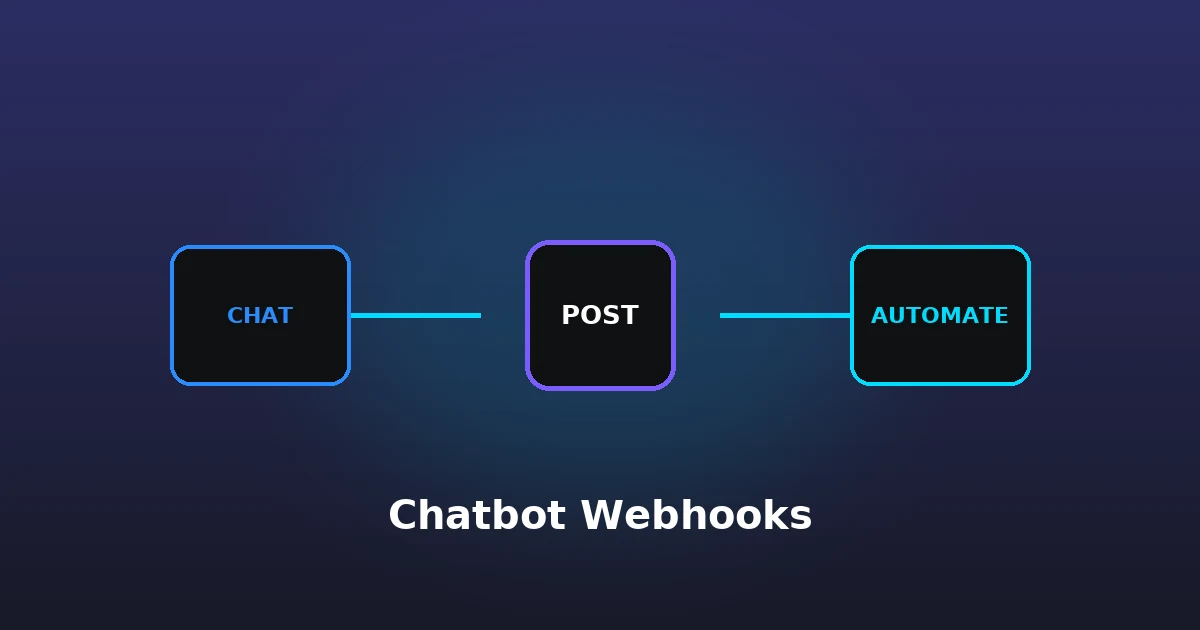
    chatbot webhook flow diagram
    A chatbot webhook pushes conversation data to your automation platform.
    • message — what the visitor typed. Your primary signal for intent: “pricing” versus “support” versus “bug”.
    • reply — what the AI answered. Context your team needs later so a rep does not repeat themselves.
    • sessionId — a unique id that groups all messages from one conversation into a single thread. This is how you reconstruct a full conversation from many individual pushes.
    • url — the page the visitor was on when they messaged. A message on /pricing/ and one on /support/ mean very different things.
    • timestamp — when the interaction happened, used for time-sensitive follow-ups.

    Notice what is conspicuously absent here: there is no automatic email in the payload. A webhook fires for every message, not only when a visitor volunteers their contact details. That is actually good news — it means you never miss a conversation that never turned into a form fill. If you need an email, you collect it inside the conversation (asking the visitor) and then handle it in your workflow, rather than expecting the payload to include a field the visitor never gave up.

    How a Chatbot Webhook Flows Through n8n

    The cleanest way to see this working end to end is with n8n — a popular open-source automation tool. Here is the complete flow, step by step, so you know exactly what is happening behind the scenes.

    The webhook trigger node

    In n8n, add a Webhook node and set the HTTP method to POST. n8n hands you a unique URL of the form /webhook/your-unique-id. This is your endpoint — the address the chatbot will push data to.

    The chatbot sends the payload

    In your WordPress chatbot settings, enable the webhook integration and paste the n8n URL. Now, every time a visitor sends a message and the chatbot replies, WordPress POSTs the JSON payload to that URL. n8n receives it as its trigger event.

    Filter, transform, and act

    From the trigger, add further nodes. A Filter node can drop messages that do not meet a condition (for example, ignore everything not from a /pricing/ page). A Set or Code node maps the payload fields into the shape your target system expects. Finally, an action node — Slack, Google Sheets, HubSpot, HTTP Request — does the actual work.

    The result is a live pipeline: a visitor messages your chatbot, and within seconds the lead is in Slack, the sheet, and the CRM without anyone lifting a finger. That is the entire point of connecting a webhook to an automation platform.

    Three Automations That Use the Payload

    To make this concrete, here are three automations that take minutes to set up and solve real problems. Each starts with the same webhook trigger; the difference is what happens after the payload arrives.

    1. Slack alert for buying intent

    Add a filter that only forwards messages where the url contains /pricing/ or /plans/. Map message and reply into a Slack notification. Your sales team now sees a hot lead the moment it happens, instead of hours later when the visitor has gone. Speed-to-lead matters: the faster a rep responds, the more likely a visitor is to convert.

    2. Google Sheets lead log

    Map each payload field to a column and write a new row per message. You get a clean, searchable, filterable record of every conversation — not just the winners, but everything. That becomes the raw material for your reporting and your follow-up queues. Add a “handled” column and update it as you work through leads.

    3. CRM contact creation

    Map the payload to a Create Contact action in HubSpot, Pipedrive, or Similar. Use the page URL to pick the correct pipeline — a /pricing/ visitor goes to sales, a /support/ visitor goes to support. Attach the AI reply as a note so the rep opens the record knowing exactly what was already discussed. Because the webhook fires on every message, no conversation is ever lost, even those that never turned into a form submission.

    The common thread is that the webhook gives you the raw material, and the automation platform decides what to do with it. You can combine these patterns — filter in n8n, log to a sheet, and create CRM records selectively — without writing any custom code.

    n8n vs Zapier vs Make: Which Automation Tool?

    Once you know you want to automate your chatbot’s webhook, the next question is which platform to run the automation on. The three most common choices are n8n, Zapier, and Make, and they differ in ways that matter for small teams and self-hosted setups.

    n8n

    n8n is an open-source automation platform that you can run yourself, which makes it a natural fit if you are already self-hosting your chatbot. It has a visual, node-based editor, supports hundreds of integrations, and can be hosted on your own server so your automation stays under your control too. It has a steeper learning curve than the hosted alternatives, but for a technical user it is the most flexible and the most private option. The official n8n documentation on connect your workflows to other systems is a solid starting point.

    Zapier

    Zapier is the easiest to set up and the best known. Its strength is the sheer size of its app directory — thousands of pre-built integrations mean the tool you need is probably already there. The trade-offs are cost (pricing tiers based on tasks per month) and that everything runs on Zapier’s hosted infrastructure, so your data passes through their servers. For a non-technical user who just wants Slack and sheets working in minutes, it is hard to beat.

    Make

    Make (formerly Integromat) sits between the two. It has a visual flow editor that is friendlier than n8n’s and more powerful than Zapier’s “if this then that” model, with a generous free layer. Like Zapier it is hosted, so your payloads pass through Make’s servers. It is a strong middle ground for a business that wants flexibility without running its own automation server.

    Which one is right depends mostly on two questions. First, do you want to host the automation yourself? If yes, n8n is the natural choice. Second, how much money do you want to commit to per-task pricing? If a generous free tier matters, Make is attractive; if you value the broadest integration catalog above all, Zapier leads.

    Security and Reliability

    A few habits keep your webhook safe and stable, and they are worth getting right from the start.

    Use HTTPS

    Prefer HTTPS URLs so the payload travels encrypted between your server and your automation platform. A plain HTTP endpoint could expose conversation data in transit.

    Protect the endpoint

    Treat your webhook URL as a secret. Anyone who discovers an unauthenticated webhook URL could POST arbitrary junk into your workflow, which then shows up in Slack, your sheet, or your CRM. If your automation platform supports it, add a shared-secret header or verify a token before acting on the payload.

    Handle failures

    Webhooks are fire-and-forget by design. If the receiving endpoint is down when the chat fires, the push may be lost. In n8n and Make you can add error handling — a retry, a fallback branch, or a notification — so a failed step never silently drops a lead. For a self-hosted chatbot, your own infrastructure is the source, and your automation is the receiver, so you control both ends of the reliability question.

    YakWP and Webhooks

    YakWP, the self-hosted WordPress chatbot, includes a built-in webhook integration in the free plugin. Enable it in settings, paste in your n8n, Zapier, or Make URL, and every visitor message is forwarded as a clean payload with all five fields described above. It works with n8n, Zapier, Make, Pipedream, or any service that accepts a webhook POST — with no extra subscription and no third-party relay, because the data goes straight from your own server to the endpoint you choose.

    For a full, step-by-step build of a lead pipeline, see our guide to using a WordPress chatbot with n8n, which walks through the payload, the workflow, and the scaling decisions in detail.

    Common Webhook Mistakes to Avoid

    Most problems people hit with chatbot webhooks come from a small set of avoidable mistakes. Knowing them in advance saves real debugging time.

    Expecting the payload to contain an email

    A webhook fires for every message, and a visitor rarely hands over their email as the first thing they type. Build your workflow around the fields you actually receive — message, reply, sessionId, url, timestamp — and collect an email inside the conversation if you genuinely need one. If you design around a field that is not there, every run silently fails.

    Forgetting that the same visitor sends many messages

    Because the webhook fires per message, one visitor can produce several pushes in a single session. Use the sessionId to group them into a thread, or your Slack channel and spreadsheet will fill with every single question rather than one conversation per visitor. Decide up front whether you want one row per message or one row per session.

    No failure handling

    A webhook is one push with no automatic retry. If your automation endpoint is briefly down, that push is gone. Add a guard in the receiving workflow — a fallback branch that logs the failure, or a notification — so a transient error does not silently swallow a lead.

    Logging everything without a plan

    Capturing every conversation is good, but a flood of undifferentiated rows is not useful. Decide what you will act on and add a filter early in the workflow, so the automation routes the important messages to action and sends the rest to a quiet log rather than blasting your whole team.

    Frequently Asked Questions

    Is a webhook the same as an API?

    Not quite. An API lets your code pull data on request. A webhook is a push – a service sends data to a URL when something happens. For automation, pushes are immediate and fire only when relevant.

    Do I need to know how to code to use a chatbot webhook?

    No. Modern automation platforms like n8n, Zapier, and Make let you connect a webhook trigger and map fields visually, without writing code. A basic understanding of JSON helps, but you do not need to be a developer.

    What if my webhook call fails?

    Webhooks are fire-and-forget, so a failed call can drop data. Add error handling in the receiving workflow – a retry, a fallback branch, or a notification – so nothing is silently lost.

    Can a chatbot webhook send my data to a third party?

    Only if you point the webhook at a third-party URL. A self-hosted chatbot sends the payload to whichever URL you configure, so you control exactly where the conversation goes.

    What does self-hosted mean for a webhook chatbot?

    A self-hosted chatbot runs on your own WordPress server, and its webhook sends the conversation directly to the endpoint you choose. There is no middleman relay and no per-message fee.

    Conclusion

    A chatbot webhook is the bridge that turns a helpful chat window into an automation engine. By pushing the visitor message, the AI reply, the session, and the page URL to a tool like n8n, Zapier, or Make, you can alert your team, log your leads, and feed your CRM automatically — no coding required. If you run WordPress and want a self-hosted chatbot with a built-in webhook that sends your data where you choose, YakWP does it out of the box, straight from your own server.

  • What Is an AI Chatbot? A Complete Guide for WordPress Owners

    What Is an AI Chatbot? A Complete Guide for WordPress Owners

    ▶ Listen to this article

    If you have landed here, you have likely seen a chat window pop up on a website and wondered what is running behind it. What is an AI chatbot, exactly, and how is it different from the clunky help boxes of a decade ago? The short answer: an AI chatbot is software that uses machine learning and large language models to hold a conversation with you in natural language, rather than following a fixed script. This guide unpacks what an AI chatbot is, how it works, the key difference from rule-based bots, and how businesses actually use one.

    What Is an AI Chatbot?

    A chatbot is a computer program designed to simulate a conversation with a human user. The phrase AI chatbot narrows that definition: it is a chatbot powered by artificial intelligence, usually a large language model (LLM), that can understand a question in natural language, work out roughly what you mean even when your wording is imperfect, and generate a reply that reads like it came from a person.

    The key distinguishing feature is flexibility. A traditional bot matches your input against a list of pre-written rules, so a slightly different phrasing breaks it. An AI chatbot interprets meaning and can answer questions it has never seen before because it was trained on enormous amounts of text. That is why a modern AI chatbot can handle open-ended questions, small talk, and follow-ups, while older bots could only handle a handful of scripted paths.

    Chatbots With AI vs Rule-Based Chatbots

    To understand what an AI chatbot is, it helps to set it against the alternative.

    Trait Rule-Based Chatbot AI Chatbot (LLM-based)
    How it decides what to say Matches keywords to a fixed decision tree Generates a reply from a language model based on meaning
    Understands phrasing changes No — any rewording can break it Yes — understands meaning, not just keywords
    Handles new/unseen questions No — only scripted paths Yes — can reason about novel inputs
    Maintenance Every new intent must be added by hand Learns from the model, not manual rules
    Conversation flow Rigid, step-by-step Natural, can change direction
    Best for Simple, predictable tasks (resets, status checks) Open-ended questions, support, sales

    Rule-based chatbots have been around since the 1960s, when early programs like ELIZA used simple pattern matching to mimic a therapist. AI chatbots built on modern language models only became practical in the early 2020s and have since become dramatically better and cheaper. If you want the full scholarly background on how the field evolved from those early pattern-matching systems to today’s language models, the chatbot history on Wikipedia is a good starting point.

    What Chatbots Do in the Real World

    customer support agent at a desk with headset
    AI chatbots answer at any hour and hand off when a human is needed.

    It helps to think about what an AI chatbot actually does for a visitor, not just how it is built. When someone lands on a website and asks the chat widget “Do you ship to Serbia?” or “Does this work with WooCommerce?”, they do not care whether there is a neural network inside. They care that they get a fast, correct, useful answer. An AI chatbot earns that trust by being genuinely helpful rather than clever-sounding.

    In practice that means a good AI chatbot keeps a few promises. It answers in seconds, it stays consistent with what the business actually sells, it remembers what was already said, and it knows when to hand the conversation to a real person. The best deployments are the ones you barely notice: the bot quietly resolves the routine questions, and a human only appears for the conversations that need judgment, empathy, or a decision. That division of labour is what makes an AI chatbot economical — it is not replacing people, it is absorbing the repetitive load so people can spend their time on the work that actually needs them.

    There is also a question of who owns the conversation. With a hosted AI chatbot, every message your visitor sends is routed to a third-party server, stored on infrastructure you do not control, and occasionally used in ways you have to trust. With a self-hosted AI chatbot, the conversation lives in your own database and runs against an API key you control. For a site that collects emails, takes orders, or handles anything sensitive, that distinction matters more than the model behind the answers.

    How an AI Chatbot Works

    hand-drawn workflow diagram on a whiteboard

    Grounding a chatbot in your own content works much like mapping a workflow.

    Under the hood, an AI chatbot is powered by a few connected pieces.

    Large Language Models

    The engine is a large language model trained on a vast amount of text. When you type a question, the model predicts the most likely next words and generates a coherent reply. Models from providers like Google Gemini, OpenAI, or open-source options all do this, and the quality varies widely between them.

    Understanding Meaning, Not Just Keywords

    Because the model was trained on language, it understands meaning. Ask “how much does this cost” and a good AI chatbot can surface the pricing page even if the phrase “cost” never appears there. This semantic understanding is what separates a modern AI chatbot from a keyword-matching bot.

    Grounding with Your Own Content (RAG)

    Many AI chatbots for websites do not rely on the model alone. They use retrieval-augmented generation, or RAG: the bot first looks up relevant content from your site or knowledge base, then feeds that context to the model so the answer stays grounded in your real information. This dramatically reduces the chance of the chatbot inventing a wrong answer, because it answers from your actual pages. You can read more about how this works in our look at semantic search for chatbots.

    Memory and Context

    A good AI chatbot remembers what was said earlier in the conversation so follow-ups like “and what about the paid plan?” make sense. This conversational memory is a big part of why people describe modern chatbots as feeling human.

    Guardrails and Safety

    Reputable AI chatbots then apply guardrails so they do not answer harmful, off-topic, or legally risky questions. On a business website, these rules keep the bot safely within the role you gave it, such as “support only.”

    The Main Types of Chatbots

    AI chatbots are not one thing. They tend to fall into a few common roles.

    Customer Support Chatbots

    These answer common questions, resolve simple issues, and hand off to a human when needed. They are the most widespread use case and the biggest driver of reduced support ticket volume.

    Sales and Lead Generation Chatbots

    These qualify visitors, answer product questions, and capture contact details — an email address or a buyer signal — before a human salesperson picks up. On a WooCommerce or business site, this can turn anonymous visitors into a warm lead list.

    Internal and Explain Chatbots

    Many companies deploy a chatbot that answers questions about their own documentation, policies, or products for employees or curious visitors. Because it is grounded in the company’s own content, it gives consistent, accurate answers.

    Ecommerce and WooCommerce Chatbots

    online shopper browsing a product catalog on a laptop

    For stores, an ecommerce chatbot can answer product and shipping questions instantly.

    Shops use AI chatbots to answer shipping, returns, and product questions, and to guide customers toward a purchase. A free WooCommerce chatbot can add instant answers without a monthly SaaS commitment.

    Personal Assistant Chatbots

    These are your everyday conversational assistants that help with research, writing, planning, and day-to-day tasks. The same underlying technology powers both a personal assistant and a business chatbot.

    Why Businesses Add a Chatbot to Their Website

    There are four reasons that consistently come up when owners explain why they added one.

    Round-the-Clock Availability

    An AI chatbot answers questions at 2 a.m. on a weekend. It never sleeps, never takes a break, and never keeps a customer waiting for a reply that may never come.

    Lower Cost and Faster Answers

    Because a chatbot handles the repetitive 80 percent of questions, human staff can focus on the cases that genuinely need them. That lowers support cost and cuts average response time.

    Lead Capture Without Friction

    Sales chatbots can quietly collect an email the moment a visitor shows buying intent. Instead of forcing a visitor to find a contact form, the bot captures the lead inside the conversation.

    Data You Actually Own

    One of the biggest differences between options is where the conversation data lives. With a self-hosted AI chatbot, every conversation stays in your own database and your own infrastructure, which matters for privacy and compliance. Many owners specifically value the control that comes with why bring-your-own-key matters.

    Chatbots and WordPress: What Fits You

    If your website runs on WordPress, you have a wide range of choices, from SaaS widgets you paste in to self-hosted plugins you install yourself. The right one depends on a few practical questions.

    Are you willing to pay a monthly subscription? If you prefer no recurring fee and full control, a self-hosted plugin that runs on your own hosting and uses your own API key is worth a serious look — and it is the approach we built YakWP around. To see how much setup really takes, read our guide on how to add an AI chatbot to WordPress in 5 minutes.

    Do you want a ready-made comparison first? Reviewing the available options side by side saves time, and we keep a running comparison of the best free chatbot for WordPress.

    How to Evaluate a Chatbot Before You Commit

    Because so many AI chatbots look similar on paper, it pays to judge them on the things that actually affect your day-to-day experience. Start with the model. A chatbot is only as good as the language model powering it, and models differ a lot in accuracy, tone, and how naturally they follow instructions. Check which providers it supports and whether you can bring your own key rather than being locked into whatever the vendor bundles.

    Next, look at how the chatbot gets its knowledge. The best AI chatbots for a business website pull from your own content so they answer from what is actually true about your product, rather than from general training data. This grounding is what stops an AI chatbot from inventing a pricing detail or a feature that does not exist. Ask specifically whether the tool indexes your pages and keeps that index updated automatically, because a static knowledge base quickly goes stale.

    Then think about the edges, not the happy path. What happens when a visitor asks a question the bot cannot answer? Is there a clear handoff to a human? Can you see and export the conversations? Is there rate limiting so the bot cannot be abused? And critically for any business, where does the data go — does it stay in your control or pass through a vendor’s servers? A platform that answers these honestly is far more trustworthy than one that only shows off a polished demo.

    Finally, weigh the total cost. A hosted AI chatbot usually arrives as a monthly subscription, and that recurring fee can grow as your traffic and conversations grow. A self-hosted AI chatbot with your own API key typically has no subscription at all — your only ongoing cost is the model usage you already pay for, often on a free tier. For a small site or an agency running several client sites, that difference can be substantial over a year.

    How to Choose the Right Chatbot

    Choosing between the many AI chatbots available comes down to four decisions.

    Self-Hosted vs SaaS

    A hosted service is the fastest to set up but adds a monthly fee and routes your visitors’ conversations through a third-party server. A self-hosted option runs on your own hosting, keeps your data local, and typically has no recurring cost — you just pay for your own API key usage.

    Bring Your Own Key vs Included Model

    Some plugins bundle a model into the subscription price. Others let you connect your own API key from a provider like Google Gemini or OpenAI, which can be far cheaper and gives you a choice of models, from free-tier options to high-end ones. This freedom is exactly what BYOK is about.

    Free vs Paid Feature Set

    Most good plugins have a genuinely usable free tier and a paid tier that adds extras like branding removal, export, or custom styling. Understanding the split before you install avoids surprises. If YakWP is one you are weighing, our YakWP Free vs Pro comparison spells out exactly what you get at each level.

    Ease of Setup and Maintenance

    You want software that is quick to install and does not demand constant babysitting. A plugin that works with a few clicks and keeps your content in sync automatically is far better than one you have to maintain by hand.

    Limitations and How to Handle Them

    No AI chatbot is perfect, and it is worth being realistic.

    • It can be wrong. A model can occasionally produce a confident but incorrect answer. Grounding the bot in your own content with RAG, and adding a “talk to a human” fallback, are the two best safeguards.
    • Set the right expectations. A chatbot is not a replacement for good human support. Use it to handle the routine and hand over the complex.
    • Keep the model updated. The quality of answers tracks the quality of the model and the freshness of your content. Refresh both over time.
    • Reviews depend on your content. A chatbot that answers from an outdated site will give outdated answers. Keep your pages current.

    Frequently Asked Questions

    What is the difference between a chatbot and an AI chatbot?

    A regular chatbot follows a fixed set of rules and scripted replies, so it struggles with any wording it has not been told about. An AI chatbot uses a language model to understand meaning and generate replies, so it can handle questions it has never seen before.

    Do AI chatbots need an API key?

    Most modern AI chatbots do, because the actual intelligence comes from a large language model accessed through an API. With a bring-your-own-key setup, you connect your own key and pay the provider directly, sometimes on a free tier with generous limits.

    Are AI chatbots safe to use on my website?

    Yes, when configured sensibly. Choose one that grounds answers in your own content, applies guardrails to stay on topic, and gives visitors a clear path to a human. Keeping your data on your own hosting also strengthens privacy.

    Can an AI chatbot help my business without being expensive?

    It can. A self-hosted AI chatbot with your own API key has no monthly subscription, and the free tiers of several major model providers are generous enough for a busy small site. That combination keeps the cost near zero while still answering customers round the clock.

    What is a large language model?

    A large language model is an AI system trained on a huge amount of text to predict and generate natural language. It is the technology that lets a modern AI chatbot understand questions and write coherent, helpful answers instead of returning fixed scripted lines.

    Conclusion

    An AI chatbot is software that uses a large language model to understand what people mean and reply in natural language, which is a big step up from the scripted, rule-based bots of the past. Its real value to a business is that it works around the clock, lowers support cost, captures leads, and can be grounded entirely in your own content so answers stay accurate — especially when it runs on your own hosting with your own API key.

    If you run WordPress and want a self-hosted AI chatbot with no monthly fee and full control over your data, YakWP is built exactly for that. You install it, connect your own key, and the free version works without limitations. For a head-to-head view of the landscape first, browse our best free chatbot for WordPress comparison, and for automating the conversations you capture, see how to pair one with n8n.

    Try YakWP on your own WordPress site — install it, connect your own API key, and the free version works without limits. See the pricing or start with the free download.

  • OpenRouter Review: 466 AI Models, a Real Free Tier, No Subscription

    OpenRouter Review: 466 AI Models, a Real Free Tier, No Subscription

    ▶ Listen to this article

    Server data center hosting AI models
    One gateway in front of hundreds of model providers.

    This is an in-depth OpenRouter review born from real testing: one API key, 466 models, no subscription, and a free tier that actually works.

    I have spent years juggling model APIs. Separate accounts at OpenAI, Anthropic, Google, then a half dozen smaller providers, each with its own dashboard, its own billing, its own rate limit table I was supposed to memorize. Every new model meant another signup. OpenRouter fixes exactly that, and it has a genuinely usable free tier that most people never find.

    This is the review I wish I had before I hit the signup page. Real numbers from the live API, the free models that are actually worth your time, the rate limits that matter, and the honest cases where you should skip it.

    What OpenRouter is

    OpenRouter is a gateway. Not a model company. It sits in front of hundreds of open and proprietary models and serves them all through one OpenAI-compatible endpoint.

    When you call a model, OpenRouter routes to the provider hosting it, and if that provider is down, the request falls over to the next one automatically. You get one key, one invoice, one analytics dashboard. The providers change underneath you. The interface does not.

    The free tier is the real story

    Here is what most review pages get wrong about OpenRouter. The free models are not demos. As of this month the API lists 22 models at $0 — 17 carrying a :free build, plus the free-model router, two Google Lyria audio previews, one stealth model (Space Bunny Alpha), and inclusionAI’s free Ling 3.1 Flash — and the chat models among them are legitimate production models, not crippled trials.

    The free lineup includes Google’s Gemma 4, NVIDIA’s Nemotron 3 and 3.5 series, Thinking Machines’ Inkling, Qwen 3.8 27B, and more. Four of them carry a full million-token context window — Nemotron 3 Ultra 550B, Nemotron 3.5 Lightning, Inkling and Inkling Small. A million tokens, free. One casualty of the last rotation: Z.AI’s GLM-5.2 lost its free build and is now paid only ($0.02 in / $16.00 out per million), so it is off this list. The roster keeps rotating: inclusionAI’s Ling 3.0 Flash also went paid, and its successor Ling 3.1 Flash is the free inclusionAI entry now.

    Model Context Notes
    Google Gemma 4 31B 262K Reliable general purpose
    Google Gemma 4 26B 262K Lighter, faster
    NVIDIA Nemotron 3 Ultra 550B 1M Biggest free option
    NVIDIA Nemotron 3 Super 120B 262K Strong all rounder
    NVIDIA Nemotron 3 Nano 30B 256K Fast, high volume
    Thinking Machines Inkling 1M New, huge context
    NVIDIA Nemotron 3.5 Lightning 1M Newest free head, huge context
    Thinking Machines Inkling Small 1M Lighter sibling of Inkling
    Qwen 3.8 27B 262K Strong open-weight all-rounder
    InclusionAI Ling 3.1 Flash 262K Fast, light coding and chat
    Poolside Laguna XS 2.1 262K Smaller code model
    Dots 3 Note Preview 512K Huge context
    Cohere North Mini Code 256K Code focused
    Poolside Laguna S 2.1 262K Code generation

    Pick the right free model and you can run real workloads on it. For a prototype, a hobby project, or a low-traffic tool, the free tier alone is enough to launch.

    The rate limits you need to know

    Free does not mean unlimited. Without credits, free models run at 20 requests a minute and 50 requests a day. That covers testing and building. It will not run a public chatbot.

    Here is the trick that changes everything. Buy $10 of credits once, and the daily cap on free models jumps to 1,000 and stays there. The $10 is not consumed by the free models. It simply sits on your account for when you call a paid model. One purchase, and the free tier becomes genuinely usable for the week, not just the afternoon.

    How the billing works

    OpenRouter passes through whatever the model provider charges. There is no markup on the tokens. The company makes its money on the credit purchase itself, not on usage.

    The cheap end of the catalog runs at fractions of a cent per thousand tokens:

    Model Input Output
    Mistral Nemo $0.02 $0.03
    Qwen 3.7 Flash $0.03 $0.13
    OpenAI GPT-OSS 120B $0.037 $0.17
    Cohere Command R7B $0.04 $0.15
    Amazon Nova Micro V1 $0.04 $0.14

    A long running prototype can cost less than a coffee. When you only pay pennies for a thousand tokens, you stop thinking about usage and start thinking about what to build.

    Bring your own key

    If you already pay OpenAI, Anthropic, or Google directly, you do not need to buy OpenRouter credits at all. The BYOK program lets you plug your existing keys into OpenRouter and use it purely as a unified interface.

    That setup gives you a million free routing requests a month. Past a million, OpenRouter charges a 5% routing fee on top of what the provider charges. For one interface over every key I own, with fallback and analytics included, I consider that fee a fair deal.

    Privacy is handled, not promised

    By default OpenRouter logs nothing of your prompts or completions. Not even when a request errors. Only billing metadata, timestamps, and token counts are kept. Your text stays yours.

    There is an opt-in setting that trades that logging for a 1% discount on usage costs. It is off by default, and you have to switch it on deliberately. For a company whose whole business is passing data between you and model providers, that default deserves credit.

    Those model suffixes explained

    The model IDs end in a suffix that tells OpenRouter how to route the call. It looks like noise until you know what they mean.

    • :free uses free tier hosting where available.
    • :nitro routes to the fastest provider.
    • :floor routes to the cheapest provider.
    • :thinking enables reasoning mode on models that support it.
    • :extended routes to a provider offering a longer context window.

    So deepseek-r1:free gets you a reasoning model for nothing, and llama-3.3-70b:floor gets you a paid model at its cheapest source. The suffixes stack on top of any model you already know.

    Where it falls short

    I tested the free tier properly, and I want to be honest about the limits.

    Do not run production traffic on free models. No SLA, hosting can drop out, and 20 requests a minute dies the moment a second user opens your app. The free tier is for building and proving an idea, not for scale.

    The free roster also rotates. A model that is free today can lose its free hosting next month. The :free router picks whatever is available, but you lose the choice of a specific model.

    And the credit purchase fee is the catch. If you spend heavily on a single provider, the direct route is sometimes cheaper. OpenRouter wins on convenience and breadth. It does not always win on pure price.

    Who should use it

    Get it if you compare models, if you build something that might switch providers, or if you want to prototype on free models before paying. Get it if you already hold several provider keys and want one dashboard.

    Skip it if you use one model from one provider and nothing else. The credit fee is pure overhead there, and you are better off going direct.

    FAQ

    Do I need a credit card to start?

    No. The 22 free models work the moment you sign up. Credits are only needed to lift the daily cap or call paid models.

    Is it a drop in replacement for OpenAI?

    Mostly. Point your client at the base URL, drop in your OpenRouter key, and the request format matches. Code that targets OpenAI generally works unchanged.

    What does OpenRouter charge?

    A fee on credit purchases, and a 5% routing fee on usage above a million BYOK requests a month. Model pricing passes through with no markup.

    Which free model is best right now?

    Gemma 4 31B or Nemotron 3 Super for general work. Nemotron 3 Ultra 550B or Nemotron 3.5 Lightning if you need the million token context. North Mini Code or Laguna for code.

    Can this replace my provider?

    If you use several, yes, it replaces most of the friction. If you use one, it is overhead. It is a gateway, not a model.

    The bottom line

    The thing I keep coming back to is the friction it removes. No new account at every lab. No memorizing five rate limit tables. No logging into a different billing page to understand a single invoice.

    One key, and behind it, everything. Start on the free tier, put $10 down if the daily cap bites, and decide from there. If it is not for you, testing it costs nothing at all.

    Sign up at openrouter.ai. No credit card needed to start.

  • Best Free Chatbot for WordPress: Top Plugins Compared (2026)

    Best Free Chatbot for WordPress: Top Plugins Compared (2026)

    TL;DR: The best free chatbot for WordPress is YakWP, because it is self-hosted, brings your own AI key, has no per-conversation fee and no site limit. Every hosted free tier caps conversations or gates the AI features.

    What “Free” Actually Means for a WordPress Chatbot

    Half the plugins that call themselves free mean “free until you grow”. Three questions separate a permanently free chatbot from a trial with friendly wording.

    Who pays for the AI? Every AI answer costs somebody money. If the plugin company pays, your free tier needs a ceiling to stay viable, and that ceiling shows up as a conversation count, a credit pool, or a locked feature. If you pay with your own provider key, the plugin maker has no per-answer cost to recover, so there is nothing to meter.

    Where do the conversations live? A hosted bot stores your visitors’ messages on the vendor’s cloud and runs them through its own model. A self-hosted plugin keeps the transcript and the content index in your own WordPress database, and you choose which model provider receives each prompt, which is the simpler position to defend if a customer asks what happens to their data. The prompt does leave your server for the provider you connect, unless you point it at a model you host yourself.

    What is gated? Reading your pages is the feature that makes a bot useful, and it is often the feature that sits behind the paid tier. It is the single fastest way to tell whether a best free chatbot for WordPress claim holds up. Check that retrieval, memory and lead capture are in the free version before you judge a plugin by its price.

    Those three questions are the filter used to rank the best free chatbot for WordPress below. Plugins that fail the meter test or the privacy test drop out immediately.

    ▶ Listen to this article

    The Best Free Chatbot for WordPress Plugins in 2026

    Here is the shortlist, starting with the plugin that clears every filter, followed by the options you are most likely to compare against it. Prices below were checked in September 2026.

    1. YakWP: free, self-hosted, bring your own AI key (our pick)

    YakWP is a self-hosted plugin that removes the subscription entirely. You install it on your own WordPress site, connect an AI key you already own (Google Gemini, OpenAI or OpenRouter), and it reads your pages so answers come from your actual content. Because you supply the key, there is no per-conversation charge and no monthly plan attached to the plugin.

    The free version is the whole chatbot, not a sample of one, which is why it ranks first among the best free chatbot for WordPress options: four conversation modes (sales, support, explain, custom), retrieval over your own posts and pages, semantic search, conversation memory, lead capture with email notifications, an analytics dashboard, webhook integration and a live site search box. It also has no site limit, so the same free plugin runs on as many WordPress sites as you own. Pro is a one-time EUR 64 with lifetime updates, and it adds white-label branding that removes the small “Powered by Yak” credit, custom widget CSS, CSV conversation export and priority support.

    One honest caveat, because “unlimited” deserves an asterisk. The plugin has no conversation cap and no meter, but your answers run on your own API key, so the real limit is your provider’s quota. Google’s Gemini free tier covers 500 requests a day, which is more than most small sites use; beyond that your provider bills you directly for the tokens you use.

    If privacy and a flat cost matter more than a one-click setup, this is the best free chatbot for WordPress in the list, which is why it is the one we run on our own sites. It is also the option that keeps working after the free tier of a hosted competitor would have started billing. You can see how the free and paid tiers differ in our Free vs Pro breakdown.

    2. WPBot: the long-standing WordPress chatbot

    WPBot is one of the oldest chatbot plugins in the WordPress directory, rated 4.7 out of 5 across 123 reviews, and it is genuinely straightforward to configure. It handles menu buttons, simple rule-based flows, lead collection and integrations with common form and shop plugins.

    It runs without an AI service at all if you only want guided flows, and it can connect to OpenAI, Gemini, OpenRouter or DialogFlow when you want AI answers. That flexibility is also the catch: the AI side depends on that external service and on the key you connect there, and the more advanced automation features sit in the paid WPBot Pro version. It is a fair free choice for a rules-based bot, though not the best free chatbot for WordPress pick if you want AI answers generated from your own content.

    3. Tidio: fastest to launch, billed per conversation as you grow

    Tidio belongs on any best free chatbot for WordPress shortlist when live chat matters more than AI depth. It is the quickest way to put a live chat widget on a small site, and the free plan is workable rather than a demo: it includes 50 billable conversations a month and 50 Lyro AI conversations as a one-off, with a live chat widget and a basic bot on top. For a business handling a handful of conversations a day, setup takes minutes.

    The model changes as you grow. Paid plans start at $24.17 per month billed annually for 100 billable conversations, the Growth tier starts at $49.17, and every conversation beyond your allowance is billed separately. Your visitors’ chats are also processed in Tidio’s cloud. If you expect heavy volume from SEO traffic, price that per-conversation growth before you build a funnel on it.

    4. ChatBot.com: strong visual flows, free only as a trial

    ChatBot.com is built around a visual conversation designer, and for structured flows with buttons, forms and branching logic it is one of the better builders available. You can start without a credit card, which makes evaluating it easy.

    It is the best free chatbot for WordPress candidate only if you count a trial as free. There is no permanent free tier. Paid plans start at $19 per user per month billed yearly, and the AI agent that answers from your content is part of those plans rather than the free trial. Conversations are handled in their cloud. If you need designed flows and are happy to pay per user, it is a reasonable pick; if you need free to mean free, it is not the one.

    5. Elementor AI: paid tiers only, not the free builder

    Elementor’s AI features are not part of the free plugin. The entry paid plan, Essential, is $60 per year billed annually and still excludes the AI generation features, so a chatbot means moving up to the higher Elementor One tier. If your site is already deep in that ecosystem the convenience is real, but you are paying for a whole website toolkit to get one widget.

    For a site that only needs an assistant, a dedicated free plugin finishes cheaper and keeps your chat data out of the site builder’s stack, which makes Elementor the weakest of the best free chatbot for WordPress candidates on price.

    6. Chaty: channel routing, not an assistant

    Chaty solves a different problem well: it puts WhatsApp, Messenger, phone and email behind one floating button so visitors reach your existing channels. Its free tier is generous and it is a good fit for businesses whose support already happens in messaging apps.

    It is not an AI chatbot. It routes conversations to people instead of answering them, so treat it as a complement to the best free chatbot for WordPress you choose rather than a replacement for it.

    Planning a free WordPress chatbot conversation flow
    Sketch the conversation before you install anything.

    Free Chatbot Plugin Comparison

    The same six best free chatbot for WordPress candidates, judged on the criteria that decide whether free stays free.

    PluginNo conversation meterTranscript stored on your serverAnswers from your contentSite limit on free
    YakWPYesYesYes, in the free versionNone
    WPBotRules-free, AI via your keyPartlyVia the service you connectNone
    TidioNo, 50 conversations per monthNo, vendor cloudPaid tiersOne workspace
    ChatBot.comNo, trial then paidNo, vendor cloudPaid tiersOne account
    Elementor AINo, paid tiersPartlyPaid tiersPer licence
    ChatyYes, but no AINot applicable, no transcriptsNot applicableNone

    Read the first three columns together and the best free chatbot for WordPress shortlist collapses to one row: the only option that answers from your own content, stores the transcript in your own database and has no conversation cap in its free version is the self-hosted one. The rest are either widgets or hosted trials sized for small volumes.

    Checking free chatbot for WordPress analytics on a desk
    Check what the free tier reports before you commit to it.

    How to Choose the Best Free Chatbot for Your Site

    Skip the feature lists and answer four questions about your own site. The answers usually pick the best free chatbot for WordPress for you, and they are the same questions worth revisiting if you ever switch providers.

    How much traffic will chat with it? A few conversations a day fits inside any free tier. If organic traffic is your growth plan, a per-conversation model will bill you exactly when SEO starts working, which is the worst moment to add fixed costs. A plugin with no meter behaves the same at ten conversations and at ten thousand, up to your model quota.

    Does a customer’s question contain anything sensitive? Order details, account questions and pre-purchase hesitation all end up in a transcript. If you would rather not explain a third-party processor to a client, keep the bot on your own server. Our guide to self-hosted chatbots and BYOK covers that trade in detail.

    Do you want AI answers or guided buttons? Rules-based flows are cheap and predictable, and WPBot or Chaty handle them well. Generative answers need retrieval over your content, which is a different build. If you are still deciding, start with what an AI chatbot actually is before comparing vendors.

    Whichever direction those questions point, the decision is reversible, which matters more than it sounds: the best free chatbot for WordPress today is a plugin you can remove tomorrow without a contract.

    Who maintains it in six months? A hosted dashboard is easy to hand over. A plugin on your own site needs someone who can add a key and read an analytics tab, which is a lower bar than it sounds: our walkthrough adds one to WordPress in about five minutes.

    Two more situations decide it quickly. If you sell on WooCommerce, the bot needs to read product and order context, which we cover in the free WooCommerce chatbot plugin guide. If you want the bot to push qualified leads into n8n or a CRM, check that webhooks are in the free tier, as they are in ours and as we describe in the n8n integration walkthrough.

    Quick decision table

    Your situationBest fit
    Unlimited free answers, privacy, no site limitYakWP
    Rules-based flows, familiar plugin interfaceWPBot
    Live chat plus bot, small volume, live todayTidio
    Designed conversation flows, budget for seatsChatBot.com
    Already paying for Elementor OneElementor AI
    Route visitors to WhatsApp or MessengerChaty

    Signs a Free Plan Is Really a Trial

    Two red flags identify a trial wearing a free label, and both are common among the best free chatbot for WordPress results you will find on page one of Google. The first is a usage meter: a conversation count, an active-chat limit or a pool of AI credits means your free tier is a funnel toward a paid plan, and the bill arrives as soon as the bot works. The second is gating the useful feature: when reading your site, remembering context or capturing leads sits behind the paid tier, the free version is a demo.

    Compare that with a plugin where the answer, the retrieval, the memory and the lead capture are free and the only paid items are branding removal and support. There is no meter and nothing you need is locked, which is the difference between a free tier and software that is simply free.

    Developer configuring the best free chatbot for WordPress
    Bringing your own key is what removes the meter.

    Frequently Asked Questions

    Which is the best free chatbot for WordPress?

    For unlimited free answers with the data staying on your own server, a self-hosted bring-your-own-key plugin such as YakWP is the strongest option: no conversation fee, no monthly plan and no site limit on the free version. Hosted tools are better when you want a managed dashboard and live chat in the same box.

    Is there a truly free chatbot for WordPress?

    Yes. A self-hosted plugin that uses your own AI key is free by design, because you provide the model access and the hosting. That is the only best free chatbot for WordPress answer that keeps working at scale. Hosted plugins are free only up to a usage limit, which is why their pricing pages fill up with conversation counts.

    Do free chatbot plugins need an API key?

    The self-hosted ones do, since connecting your own key is exactly what removes the subscription. Hosted plugins bundle their own service instead, which is why they start billing per conversation once you pass the free allowance.

    Is a self-hosted chatbot harder to set up?

    Not meaningfully. The best free chatbot for WordPress options install from the plugin screen, and you then paste a key and point it at your content. That short setup is the same step that removes the monthly bill, and it takes minutes rather than a development project.

    Where does my chat data go?

    With a self-hosted plugin, the conversation transcript and the content index stay in your own database, while each prompt is sent to the model provider you connected. With hosted plugins, your visitors’ messages are processed and stored on the provider’s cloud, and the host’s retention policy applies.

    Can a free WordPress chatbot handle WooCommerce questions?

    It can when it reads your product and order content, which is what retrieval over your own pages gives you. That is the difference between a best free chatbot for WordPress that answers and one that only passes messages along. Free plugins that only route to human agents cannot, because they never see the data.

    What happens when I outgrow the free version?

    With a hosted tool, the answer is a subscription that grows with conversation volume. With a self-hosted plugin, the free tier does not change shape at scale; the only variable cost is model usage on the key you control.

    The Bottom Line

    The best free chatbot for WordPress in 2026 is the one that stays free once traffic arrives and keeps your visitors’ conversations under your control. Judged on that, the hosted options are excellent widgets and builders with free tiers sized for small volumes, and the self-hosted option is the one that stays free by design.

    If that matches your priorities, download YakWP free and check the pricing page to see exactly what stays free on every site you own. The plugin that answers your visitors without a meter is the one worth installing.

  • Free WooCommerce Chatbot Plugin — What’s New in YakWP 2.4.0

    Free WooCommerce Chatbot Plugin — What’s New in YakWP 2.4.0

    ▶ Listen to this article

    A free WooCommerce chatbot plugin can answer your customers instantly and close more sales while you sleep. YakWP just became a lot smarter at selling for your store: version 2.4.0 brings product-aware AI search — the chatbot now reads prices, SKUs, and categories straight from your catalog, so it answers real shopping questions instead of guessing.

    free WooCommerce chatbot plugin

    What is a WooCommerce chatbot plugin?

    A WooCommerce chatbot plugin adds a live AI assistant to your store that greets every visitor, answers product questions, qualifies leads, and guides shoppers to the right item. Because it plugs directly into WooCommerce, it can talk about the actual products you sell — availability, options, and price — using your own store data, not generic scripts.

    The best part? A free WooCommerce chatbot plugin like YakWP gives you all of this with no monthly subscription. You bring your own AI API key (Gemini, OpenCode Go, OpenAI, or OpenRouter), and the plugin takes care of the rest — no dashboard fees, no per-seat charges.

    Why choose a free WooCommerce chatbot plugin?

    Shopping questions repeat all day: “How much is delivery?”, “Do you have this in size large?”, “What’s the difference between these two?”. A free WooCommerce chatbot plugin answers them instantly, 24/7, in the visitor’s own words. That lifts conversions, cuts support tickets, and captures leads you would otherwise lose.

    Semantic (meaning-based) search is included free since version 2.3.4, so the chatbot understands questions by meaning — not just exact keywords. Ask “how much does it cost?” and it finds the product page that contains the “$29” price.

    What to look for in a WooCommerce chatbot plugin

    Not every chatbot is a real WooCommerce chatbot plugin. Many “live chat” tools are generic scripts that can’t see your products. Before you choose, check for four things:

    • Real store integration. The chatbot should read your actual products, prices, and categories — not a manual FAQ list you have to maintain.
    • Semantic search. It should understand natural-language questions, not just exact keyword matches.
    • No lock-in. A free WooCommerce chatbot plugin that’s bring-your-own-key means you control costs and data, with no monthly subscription.
    • Scale. It should stay fast as your catalog grows into hundreds or thousands of products.
    WooCommerce chatbot plugin

    New in YakWP 2.4.0 — product-aware search

    Version 2.4.0 is the biggest upgrade yet for WooCommerce stores:

    • The chatbot now knows your prices. Products are indexed together with their price, SKU, and categories, so the assistant quotes accurate prices — including the correct range for variable products like sizes or colors.
    • It scales to thousands of products. Retrieval is now bounded, so lookups stay fast even when your catalog grows into the hundreds or thousands of items.
    • More reliable automatic indexing. The daily index now self-schedules on every page load, keeping your store assistant current without any manual work.

    That makes YakWP a genuinely best chatbot for woocommerce option for store owners who want real product intelligence, not canned replies.

    How the product-aware chatbot works on your store

    After install and a one-click index, YakWP builds a searchable knowledge base of your WooCommerce products. The assistant uses it to answer natural-language questions, point shoppers to the right product, and cite the exact product page. New products and price changes are picked up automatically, and you control which content the chatbot can see.

    How to install the free WooCommerce chatbot plugin

    YakWP isn’t on the WordPress plugin directory — grab the zip from the Download page and upload it under Plugins → Add New → Upload Plugin. Already running YakWP? Get 2.4.0 from Plugins → Updates in your dashboard — re-indexing happens automatically, so there’s nothing extra to configure.

    Free forever, Pro when you need white-label

    The free WooCommerce chatbot plugin plan includes all core features plus semantic search, with a small “Powered by Yak” link. Upgrade to Pro to remove the branding and white-label the widget for your own clients.

    Frequently asked questions

    Is YakWP really a free WooCommerce chatbot plugin?

    Yes. All core features — the AI chatbot widget, four chat modes, lead capture, RAG, and semantic search — are free. You only bring your own AI API key. There’s no monthly subscription and no hidden feature paywall for core use.

    Can the chatbot handle a large catalog?

    Yes. 2.4.0 introduced bounded retrieval, so the chatbot stays fast and accurate even with thousands of products indexed.

    Do I need to write any code?

    No. Install the plugin, add your API key, and click the index button. YakWP builds the product knowledge base automatically.

    Get YakWP on your store

    YakWP is a self-hosted free WooCommerce chatbot plugin — your data stays on your server, and you pay nothing monthly. Download it free, or contact us with any questions. Have a feature you’d like next? We read every message.

  • How Semantic Search Helps Your Chatbot Understand What Visitors Really Mean

    How Semantic Search Helps Your Chatbot Understand What Visitors Really Mean

    ▶ Listen to this article

    smiling customer service representative helping a website visitor

    A single confused visitor is the silent killer of your conversion rate. Imagine someone lands on your site, looks for a specific detail, and types a question using their own words—only to have your chatbot return a “Sorry, I couldn’t find an answer” message. This happens because the page they need actually holds the answer, but the wording doesn’t match the visitor’s phrasing. This disconnect is where chatbot semantic search changes the game. It bridges the gap between how you write and how your customers actually talk, turning potential bounces into satisfied leads without you needing to rewrite a single sentence of your content.

    Beyond Keyword Matching: How Meaning Trumps Wording

    Most basic chatbots operate like a digital card catalog from the 1980s. They look for specific strings of characters. If your site has a page titled “Pricing Plans” and mentions “$29/month,” but a visitor types “What does this cost to use?”, the old-school chatbot often returns nothing. It doesn’t know that “cost” and “price” are related, or that “use” might imply a subscription. It is looking for an exact match, and because the user’s vocabulary didn’t align with your headings, the interaction fails.

    Semantic search, often called vector search, moves past this rigidity. Instead of looking for words, it looks for mathematical relationships between concepts. It treats your content as a map of ideas. When a user asks a question, the system converts that question into a set of coordinates and maps it against your existing site content. It realizes that “cost,” “price,” “monthly fee,” and “how much” all occupy the same conceptual space. It doesn’t matter if your page uses different jargon; the chatbot understands the intent behind the query and retrieves the correct information based on that underlying meaning.

    A Concrete Example: The Pricing Dilemma

    Consider a practical scenario that plays out thousands of times a day on WordPress sites. You have a landing page that outlines your service tiers. In your copy, you wrote, “Our entry-level plan is $29.” You didn’t write “price,” “cost,” or “fee” anywhere in that specific paragraph. You kept it concise and focused on the value.

    A visitor comes along and types, “How much does it cost?” into your chat window. A keyword-based chatbot scans your text for “cost” or “how much,” finds nothing, and tells the user to contact support or simply fails to reply. With semantic search enabled in YakWP, the bot calculates the vector similarity between the user’s question and your page content. It recognizes that “$29” is the answer to a question about cost. It extracts the relevant information and serves it to the visitor instantly. The visitor gets their answer, and you keep them on the page.

    AI chatbot answering a visitor question using semantic search

    The Technical Heavy Lifting Made Simple

    For most site owners, the idea of “vector search” sounds like something that requires a data science team or a complex external server. Usually, it does. You would typically need to manage embeddings, databases, and heavy API integration to make this work. We stripped all of that complexity away to make it a one-click process.

    When you enable semantic search in YakWP (now available for free in version 2.3.0 and later), the plugin creates a private index of your site. This process is fully automated. You do not need to “train” the AI in the traditional sense, nor do you need to spend hours configuring how the bot learns. You simply hit the “Build index” button in your dashboard. The plugin then analyzes your published posts and pages, converts them into a secure, private vector database, and stores it within your WordPress environment.

    This index is dynamic. Because it is tied to your WordPress workflow, whenever you hit “Update” or “Publish” on a post, the index updates automatically. Your chatbot stays current with your site content without you having to manually re-sync data or monitor for errors. It is a set-it-and-forget-it feature that adds a layer of intelligence to your site’s support layer.

    Free vs. Pro: What You Get

    We believe that high-quality semantic search should be accessible to every WordPress site, regardless of size. That is why we included it as a core feature of the free version of YakWP. Whether you are a hobbyist blogger or a growing business, you get the full power of vector search enabled on your site. The only difference between the free version and the Pro version lies in the branding and management capabilities.

    The free version includes the “Powered by Yak” link in the widget footer, which supports our ongoing development of these tools. If you are running a business that requires a fully branded, white-label experience, you can upgrade to the Pro version. The Pro license, available at our pricing page, removes the branding, enables custom CSS for your chat widget, and provides tools like conversation CSV exports so you can analyze exactly what your visitors are asking. Regardless of which version you choose, the search engine quality remains identical.

    Why Your Site Needs This Now

    The standard for online customer experience has shifted. Visitors no longer have the patience to dig through navigation menus or browse through a massive FAQ page to find a simple answer. They expect an interactive experience that functions like a conversation with a knowledgeable human who has read your entire site.

    If your chatbot provides empty results because of a minor vocabulary mismatch, you are creating friction. Every time a user has to rephrase their question or give up, the likelihood of them clicking the back button increases. By implementing semantic search, you are essentially providing a “master index” that understands the intent of every visitor, regardless of how they express themselves. This leads to higher engagement, better lead conversion, and less manual support effort from you or your team.

    Furthermore, because YakWP stores these conversations in your local database (with configurable retention settings), you can review these queries later. You will notice that many of the questions you thought were “unanswerable” are actually questions your site already has the answers for—your previous search method just wasn’t smart enough to connect the dots.

    How to Enable Semantic Search Today

    Enabling this feature is intentionally straightforward. You do not need to touch a line of code or manage an external database.

    • Step 1: Ensure you are running YakWP version 2.3.0 or higher. You can check this in your WordPress Plugins dashboard.
    • Step 2: Navigate to the YakWP settings menu in your WordPress sidebar.
    • Step 3: Look for the “Search” or “Indexing” tab.
    • Step 4: Click the “Build Index” button. The progress bar will indicate as the plugin parses your posts and pages into a vector index.
    • Step 5: Once the process completes, ensure the “Semantic Search” toggle is set to “Enabled.”

    Once you hit save, your chatbot will immediately begin using the new index to answer incoming queries. You don’t need to restart your site or wait for a cache to clear. The moment a visitor types a question, the bot will start comparing the meaning of that question against your new, intelligent index.

    FAQ

    Do I need to train the AI manually for this to work?

    No. One of the main benefits of our implementation is that it requires zero training. You simply click “Build index,” and the plugin automatically reads your published posts and pages. It creates a mathematical representation of your content (vectors) on its own. It handles all the heavy lifting in the background.

    Does this slow down my website or increase server load?

    No, the indexing process is handled efficiently to ensure your site remains fast. The search queries themselves happen quickly because the vector index is optimized for speed. Since the search is processed within your WordPress environment using the embedded data, you don’t have to worry about external latency affecting your visitor’s experience.

    Will this work if I have a lot of posts?

    Yes. Whether you have ten pages or a thousand, the system is designed to scale with your content. The “Build index” feature handles large content libraries by indexing them in a way that remains searchable and responsive. If you add new content later, the plugin handles incremental updates automatically, keeping your search index fresh every time you hit publish.

    What if I want to remove the “Powered by Yak” branding?

    The “Powered by Yak” footer link is part of the free version. If you require a white-labeled experience for your business, you can upgrade to the Pro version. The Pro license removes all branding, allows you to use custom CSS to match your site’s specific design, and includes additional features like CSV exports for your conversation logs.

  • Google AI Studio Free Tier Review: 14,400 Free AI Requests

    Google AI Studio Free Tier Review: 14,400 Free AI Requests

    Google’s free tier just changed twice in quick succession, and both changes matter if you run a website chatbot. First, Gemma 4’s free allowance jumped from 1,500 to 14,400 requests a day — a nearly 10x increase. Then Google dropped in a brand-new model, Gemini 3.5 Flash-Lite, at 500 free requests a day. Both live on the Google AI Studio free tier, the free playground Google runs at aistudio.google.com.

    Google AI Studio free tier abstract AI technology concept
    Free AI tiers keep your costs at zero.

    Here’s what actually changed, and whether either update matters for your site.

    The Headline: Gemma 4 Went From 1,500 to 14,400 Free Requests a Day

    This is the bigger of the two changes and the one most people missed. Until recently, Gemma 4 sat at 1,500 free requests a day on the Google AI Studio free tier. That was already the best free deal around — roughly 3x what the Flash-Lite models gave you.

    Now it’s 14,400 requests a day. That’s almost ten times its old allowance, and close to 29 times what the Gemini Flash-Lite models get at 500. Google essentially turned Gemma 4 from “good free option” into “run a real chatbot on this and never think about the limit again.”

    For a self-hosted WordPress chatbot, 14,400 requests a day is more conversation volume than a small or mid-size site will ever touch. You’d have to average a new message every six seconds, around the clock, to exhaust it. Let that sink in: an allowance you could never realistically hit, at a price of exactly zero.

    The Second Change: Gemini 3.5 Flash-Lite Is Now Free

    Alongside the Gemma bump, Google added Gemini 3.5 Flash-Lite to the free tier at 500 requests a day — the same allowance the older 3.1 Flash-Lite gets. The model launched with 3.6 Flash and is positioned as a low-latency, cost-efficient workhorse for high-volume tasks.

    The “Lite” name means it trades a bit of reasoning depth for speed. For a chatbot, that’s the right trade: a snappy answer usually beats a slightly more considered one. DeepMind calls 3.5 a “huge jump” over 3.1, which is what most free-tier chatbots were running on.

    So the Flash-Lite story is simple: same free price as before, noticeably better output. If you were on 3.1 Flash-Lite, switching to 3.5 is a free upgrade. And because both are one dropdown away in your chatbot settings, there’s no reason not to make the switch today.

    Google AI Studio Free Tier Lineup Right Now

    Here is the full picture from a live aistudio rate-limit panel in August 2026. Per-model limits rotate as Google ships models, so treat this as a snapshot and trust your own panel if it differs.

    Model Free requests / day Role Change
    Gemma 4 31B 14,400 Open-weight workhorse ⬆️ up from 1,500
    Gemma 4 26B 14,400 Smaller Gemma variant ⬆️ up from 1,500
    Gemini 3.5 Flash Lite 500 Fastest polished replies 🆕 new model
    Gemini 3.1 Flash Lite 500 Previous Lite default unchanged
    Gemini 3.7 Flash 20 Frontier test-only unchanged
    Gemini 2.5 Flash 20 Older Flash unchanged

    The pattern is clear. Google is generous with Gemma and the Lite line, and stingy with the flagship Flash models. That split decides which model you should actually run.

    What has moved since this was written

    Google has shipped two more generations of Flash since. The newest head of the line is Gemini 3.8 Flash, with Gemini 3.6 Flash sitting between it and 3.5. Google’s own pricing docs list every Flash generation — 3.5, 3.6, 3.7 and 3.8 — as free of charge on the free tier, so the frontier line is still reachable at $0. What the docs do not publish is how many requests a day each one allows at that price; that is the part that still lives in your own aistudio panel, and it is the tiny test-only number, not the Gemma-sized one.

    The free tier has also widened into audio. Gemini 3.8 Flash TTS and 3.8 Flash-Lite TTS, the Gemini 3.8 Live family (including 3.8 Live Extended Thinking and the 3.1 Flash Live Preview), 3.5 Live Translate and 3.5 Transcribe all now carry a free-of-charge tier. None of those existed in this lineup when the article was first written, and none of them change the chatbot recommendation below — but they are worth knowing about if you were about to pay for voice or transcription.

    What 14,400 Free Requests a Day Is Actually Worth

    Numbers like 14,400 are abstract until you convert them into the thing you actually care about: how much chatbot traffic you can serve, and what that would cost if you paid for it.

    Volume Chat requests Rough analogue
    Per day 14,400 One message every 6 seconds, 24/7
    Per month (30 days) 432,000 ~432k conversations or ~4.3M messages
    Per year 5.26M More than a busy ecommerce store

    Here is what that volume is worth on the open market. A typical SaaS chatbot service charges $49 to $99 a month and caps you at a few hundred conversations before pushing you to a higher tier. The Google AI Studio free tier gives you 432,000 conversations a month. To get that volume from a SaaS chatbot, you would be paying hundreds of dollars a month — if those tiers even exist.

    That is the real headline hiding inside this update. The free Google AI Studio free tier is not a trial or a teaser. At this volume it replaces a subscription outright, which is exactly why a self-hosted, bring-your-own-key setup like a WordPress chatbot is so appealing: you keep the free allowance, keep your data on your own server, and drop the monthly bill entirely.

    Holographic AI interface concept for the Google AI Studio free tier
    Google is banking on developers building on its free tier.

    How Google’s Free Tier Stacks Up Against the Competition

    The Gemini free tier only matters relative to the alternatives. Each major provider runs a different model: some give you a generous API free tier, some only a friendly web chat, some nothing at all.

    Provider Free API tier Free web / app chat Best free allowance
    Google AI Studio ✅ Yes, generous Gemini app 14,400 req/day (Gemma 4)
    OpenAI ⚠️ Very limited ChatGPT (usage-capped) Capped chat, small API credit
    Anthropic ❌ No free API Claude.ai (usage-capped) Web chat only
    Mistral ✅ Experiment tier Le Chat Rate-limited experiment plan
    xAI (Grok) ❌ No free API Grok app (limits) Web/app chat only

    For anyone building an API-connected product, Google is the only major player handing out a genuinely usable free API allowance at this scale. That is the strategic angle worth understanding: the free Google AI Studio free tier is not a marketing trick, it is a land grab for developers who build on top of models. The catch is that it only pays off if you adopt a setup where you keep the savings. A self-hosted chatbot captures the entire allowance; a hosted SaaS chatbot sits in the middle and skims its own margin.

    Google AI Studio free tier usage data on a tablet

    Track your allowance in the aistudio rate-limit panel.

    Which Free Model Should You Use Now?

    The Gemma bump changes the default recommendation. Before, you picked between volume (Gemma at 1,500) and quality (Flash-Lite at 500). Now Gemma 4 gives you both the volume and a big enough allowance that the 500-request ceiling on Flash-Lite looks thin by comparison.

    Here’s the clean way to decide:

    • Gemma 4 (14,400/day) — the default. Enough volume that you never think about limits, and open-weight so your data isn’t trained on. Pick this unless you have a specific reason not to.
    • Gemini 3.5 Flash-Lite (500/day) — pick this if you want the fastest, most polished responses and your traffic is light enough that 500 requests a day is plenty.

    Most sites should now run Gemma 4 and stop there. Flash-Lite is the choice for a low-traffic site where response quality and speed beat the need for headroom.

    How to Check Your Own Free Tier Limits in aistudio

    The numbers in this article came from a live aistudio rate-limit panel. Because Google rotates limits as it ships and retires models, you should confirm what your account actually gets before you build around a number. Here is the walkthrough.

    1. Open aistudio.google.com and sign in with the same Google account you use for the API key.
    2. Find the rate-limits or usage panel. Google moves this menu around from time to time, but it lives under the account menu, labeled something like Rate limits or Usage.
    3. Look up the model you plan to use. Read the free tier request limit next to its name. That number, not the one in a blog post, is the one that governs your site.
    4. Note the reset window. Some limits reset daily, others on a rolling window, so check whether your cap is per day or per hour.

    The habit matters more than the specific number. Every couple of months, open that panel and re-check the model you run. Google raised Gemma’s free tier twice in recent months. Checking a panel once a month costs you thirty seconds and keeps a $0 hosting setup honest.

    Server tower powering the Google AI Studio free tier

    The infrastructure behind 14,400 free requests a day.

    Gemma 4 vs Gemini 3.5 Flash-Lite for a Chatbot

    If you are choosing between the two free models for an actual production chatbot, here is the full trade-off, not just the headline numbers.

    Consideration Gemma 4 Gemini 3.5 Flash-Lite
    Free requests / day 14,400 500
    Speed Very good Fastest in the lineup
    Output quality Excellent Excellent, tuned for speed
    Weight Open-weight Closed model
    Data trained on your prompts? No Policy-dependent
    Best for Default, high-volume Low traffic, max polish

    For most chatbot use, choose Gemma 4. The 14,400-request allowance means you never gate your site on usage, and open-weight models give you a cleaner story about data privacy, which matters if your chatbot handles customer conversations or lead capture.

    Choose Gemini 3.5 Flash-Lite if your traffic is genuinely light, you want the lowest possible response latency, and you would rather have the most refined short answers than the biggest allowance. The right mental model is: Gemma 4 is the production workhorse; Flash-Lite is the premium-lightweight for small flows.

    Open-Weight vs Closed Models: Why It Matters Here

    This update quietly pushes Google’s open-weight line to the top of the free tier, and that is worth pausing on. Open-weight models publish their weights and run on infrastructure you control. Closed models keep their weights private and only serve you through the provider’s API.

    For a self-hosted chatbot, the practical difference shows up in two places. First, data handling: an open-weight model that processes your conversations on your own server gives you a cleaner privacy story for GDPR and customer trust than sending every message to a black-box vendor. Second, lock-in: if you host an open-weight model, you can migrate it to any provider or your own hardware. A closed model keeps you dependent on that vendor’s API, pricing, and rate limits.

    The free Google AI Studio free tier has both kinds of models side by side, which lets you test the quality of open-weight Gemma against closed Gemini before you commit. That is a genuinely useful position to be in: you get to compare, then pick the path that keeps your data and your costs under your control.

    Switching in a WordPress Chatbot Takes Seconds

    If you run YakWP on WordPress, both changes are already live in your settings. YakWP lists every free Gemini model with its daily allowance right next to the name, so you can see the new numbers without looking anything up.

    The switch is a two-step change:

    1. Go to YakWP settings and confirm the provider is Google Gemini.
    2. Open the model dropdown and pick Gemma 4 31B (for volume) or Gemini 3.5 Flash Lite (for speed).

    That’s it. No new API key, no billing change, no plugin update. Your existing AIza key from aistudio works as-is. If you don’t have one yet, grab it free at aistudio.google.com/apikey — about 30 seconds, no credit card.

    If you’re still deciding whether to self-host a chatbot at all, the BYOK explainer covers the why, and the 5-minute setup guide walks through the install.

    Data center rack of servers for free AI models

    Self-hosted means the model runs where your data lives.

    What These Changes Don’t Mean

    Two caveats so the update doesn’t read as bigger than it is.

    The frontier Flash models are still test-only. 3.5, 3.6, 3.7 and 3.8 Flash all stay in the tiny test tier on the free tier — 20 requests a day in the panel figures used here. Google is being generous with Gemma and the Lite line, not the flagship models, and a newer generation does not change that.

    Google still doesn’t publish the per-model free limits. The pricing docs do say which models are free of charge — that is how the new Flash, TTS and Live models above were confirmed — but the actual requests-per-day caps live in your aistudio rate-limit panel and nowhere else. The daily numbers in this article are from a live panel; if yours differ, trust your panel.

    Free tiers change. Google has doubled and ten-x’d allowances before, and it has trimmed them too. If you build a business on the Google AI Studio free tier, keep an eye on that rate-limit panel, and keep the option of a paid key open as a fallback.

    Frequently Asked Questions

    Did Gemma 4’s free tier really jump to 14,400 requests a day?

    Yes. It moved from 1,500 to 14,400 free requests a day, a nearly 10x increase. It’s now the largest free allowance in Google’s lineup by a wide margin.

    Is Gemini 3.5 Flash-Lite free?

    Yes, at 500 requests a day on the Google AI Studio free tier — the same allowance as the older 3.1 Flash-Lite.

    Should I use Gemma 4 or Gemini 3.5 Flash-Lite for my chatbot?

    Gemma 4 for most sites — the 14,400-request allowance removes the limit from the equation. Gemini 3.5 Flash-Lite if you want the fastest, most polished responses and your traffic fits within 500 requests a day.

    Do I need a new API key for either change?

    No. Your existing aistudio key works for both Gemma 4 and Gemini 3.5 Flash-Lite. Just select the model in your chatbot’s settings.

    Can I use more than one model on the free tier?

    Yes. The Google AI Studio free tier each model gets its own daily allowance, and they don’t share a single bucket. You can run Gemma 4 for general traffic and route to Gemini 3.5 Flash-Lite when you want the fastest replies, both at no cost.

    Is the free tier available outside the Google AI Studio free tier rate limits?

    No. The limits in this article apply to aistudio’s free tier. If you move to a paid Google Cloud or Vertex AI key, billing is per-token and you pay for the volume you actually use.

    Do the free tier limits apply to everyone?

    Your exact limits can differ from the numbers here depending on account age, region, and whether you verify a payment method. The published August 2026 figures are a good baseline; your aistudio rate-limit panel is the final word.

    What happens if I exceed the free allowance?

    Requests over the limit start failing with a rate-limit or quota error rather than silently billing you. For a chatbot, that means the widget stops answering until the window resets, so keep an eye on usage if you approach the cap on a 500-request model.

    Is the free tier enough for a real business site?

    At 14,400 requests a day, yes for nearly every small and mid-size site. That volume covers a busy self-hosted chatbot with plenty of headroom. The main risk is the frontier Flash models at 20 requests a day, which are test-only and not suitable for production.

    Can I upgrade later without changing my chatbot setup?

    Yes. You keep the same key and simply change the model or add billing in aistudio when you outgrow the free tier. A self-hosted chatbot makes that transition a settings change rather than a re-platforming project.

    The Bottom Line

    The free tier got meaningfully better this month, and the Gemma jump is the part worth paying attention to. 14,400 free requests a day is enough to run a self-hosted chatbot on a real site for $0, forever, without ever glancing at a usage counter. Gemini 3.5 Flash-Lite is a nice speed upgrade on the side.

    Put together, the Google AI Studio free tier now beats every major competitor on API volume and is the only mainstream provider giving real developers a genuinely free, large allowance. Pair it with a self-hosted plugin and that advantage lands entirely in your pocket.

    And there is a second reason this month’s change deserves more attention than a routine model bump. It is a signal about where the free AI market is heading. Google is using a large free allowance to pull developers onto its models, and at this volume the free tier stops being a trial and starts being a product strategy that replaces paid chatbot subscriptions outright.

    The practical takeaway for a small business is short: if you run a WordPress chatbot, open your model dropdown and switch to Gemma 4. You get the biggest free allowance in the market, a capable open-weight model, and one less recurring bill. If you are still picking a chatbot stack, the BYOK explainer and the 5-minute setup guide cover the rest, and the n8n integration guide shows how to automate the leads each conversation captures.

    If you run WordPress, both are already in YakWP’s model list. See what YakWP includes or grab the free plugin and point it at Gemma 4.