Problem → content
Aimed at people paying for content that does not convert. Problem, the manual cost, the fix, how it runs, why it holds up, then the ask.
Content that does not convert. Reporting that lands after the decision it was meant to inform. The same support answer typed out again. A first-customer list that stays empty. Each set below takes one of those and builds the whole argument around it — what it already costs, the fix, the proof, then the ask — vertical, sound-off first, inside a minute.
The six were produced for my own products and services rather than a client campaign. That is why no performance number is claimed anywhere on this page — and it is also why the problems below are recognisable ones rather than invented scenarios.
Most cheap GTM video is one long take with captions over it, which means any single weak beat drags the whole piece down. Splitting it into scenes at the script stage means the hook can be re-cut on its own, the stat can be swapped when the number changes, and the call to action can be tested as a variable instead of a rewrite.
Open on the situation the viewer already recognises, in their words. No brand, no intro animation, no logo sting before the point.
Scene 1What the status quo is already costing — time, money or missed work. This is the scene most in-house content skips, and it is the one that creates urgency.
Scene 2The offer, stated plainly and early. Viewers who are already sold get to act without sitting through the pitch.
Scene 3The mechanism, shown rather than claimed — screen recording, output, an actual artefact. Proof beats adjectives.
Scene 4The reason to pick this over the alternative, without inventing a testimonial or a client logo that does not exist.
Scene 5One instruction, one destination. Ordered so the ask is the last thing on screen and the first thing in the description.
Scene 6–7Each set keeps its own scene order — the arc bends to the argument, not to a template. The versions below are mine, so you can see the whole thing rather than a highlight reel.
Aimed at people paying for content that does not convert. Problem, the manual cost, the fix, how it runs, why it holds up, then the ask.
The same argument pointed at reporting that arrives too late to act on, with a screen-recorded scene rather than a claim about it.
The questions answered by hand every week — the same reply typed out again. The fixed state is shown as a chat exchange instead of asserted.
Hook, the number, where the demand actually is, the single lever that moves it, what to do first, close. Built for someone with no audience yet.
Pitched at agencies who need the work done under their own name: hook, stat, the reason to outsource, the offer, how it works, terms, close.
A paid-audit offer, re-cut after the first generation. The scene split is what made the re-cut cheap — individual beats were replaced without reshooting the set.
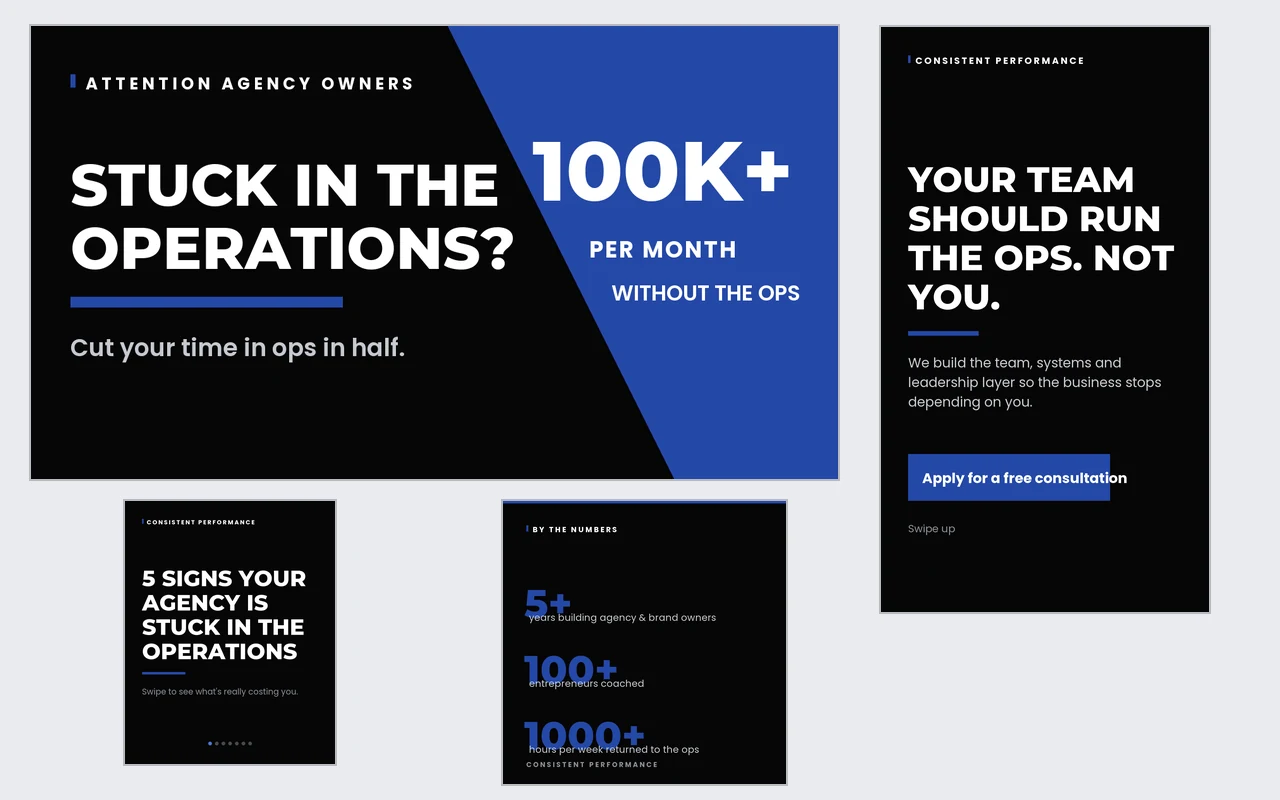
GTM does not stop at video. Carousels, thumbnails, Story covers and feed cards built inside the brand's own design system, so the video and the stills do not look like two different companies.
Honest limits. I produce the content and the argument structure. I do not run your ad account, promise a conversion rate, or claim results for campaigns that have not run — none of these sets has a client performance number attached, because they are mine, not a client's.