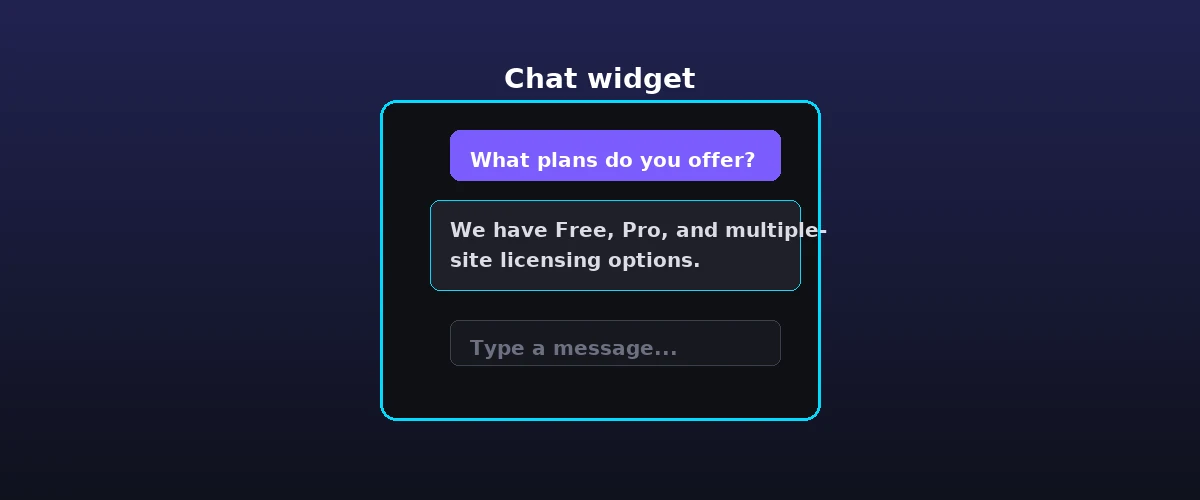

For most teams, the chatbot woocommerce shortlist starts with support volume. If you run a WooCommerce store, a chatbot can answer customer questions, suggest products, and take pressure off your inbox. The most affordable option in 2026 is YakWP, which is free on any number of sites and only costs EUR 64 for a lifetime Pro license. This guide walks through what a chatbot for WooCommerce does, how to pick one, and what it really costs.
What Does a Chatbot WooCommerce Plugin Actually Do?
Pricing matters more than feature lists across chatbot woocommerce. A chatbot for WooCommerce sits on your site and talks to visitors in real time. It can answer questions like “Where is my order?” or “Do you have this in size 10?” without you lifting a finger. The bot reads your product pages, your FAQ, and your policies, then gives a plain answer using your own words.
Setup effort is the hidden cost in any chatbot woocommerce decision. The key is that it uses your store’s content, not generic internet knowledge. So if you sell handmade candles and someone asks about shipping to Canada, the bot checks your shipping page and replies with your exact policy. That is the difference between a toy and a real sales assistant.
Data ownership decides it for regulated teams weighing chatbot woocommerce. Most WooCommerce chatbot plugins also capture leads. If a visitor asks a question the bot cannot answer, it can collect their email and let you follow up later. That turns a casual browser into a potential customer.
Chatbot WooCommerce: How Much Does a WooCommerce Chatbot Cost in 2026?
Response quality, not raw speed, separates chatbot woocommerce in practice. Prices vary wildly, and the cheapest option is not always obvious. Here is a straight comparison of the main players, using verified pricing from their own sites.
| Tool | Free Plan | Paid Plan Starts At | What You Get |
|---|---|---|---|
| YakWP | $0, no site limit | EUR 64 one-time (Pro) | Full chatbot, BYOK, lifetime updates on Pro |
| Tidio | $0, 50 conversations/mo | $24.17/mo billed yearly | 100 billable conversations, AI extras limited |
| Intercom | From $0.99 per AI outcome | $99/mo Pro add-on | Per-resolution pricing, plus seat fees |
| Chatbase | $0, 50 message credits/mo | $40/mo | 700 message credits, agents deleted if idle |
| ChatBot.com | No free plan | $19 per user/mo | 1 AI agent, 10 AI resolutions |
Notice the pattern. Most tools charge a monthly fee that grows as you get more conversations. YakWP is different because the free tier has no site limit and the Pro version is a one-time payment. For a small store, that can save hundreds of euros per year.
Chatbot WooCommerce: Why “Bring Your Own Key” Matters for WooCommerce
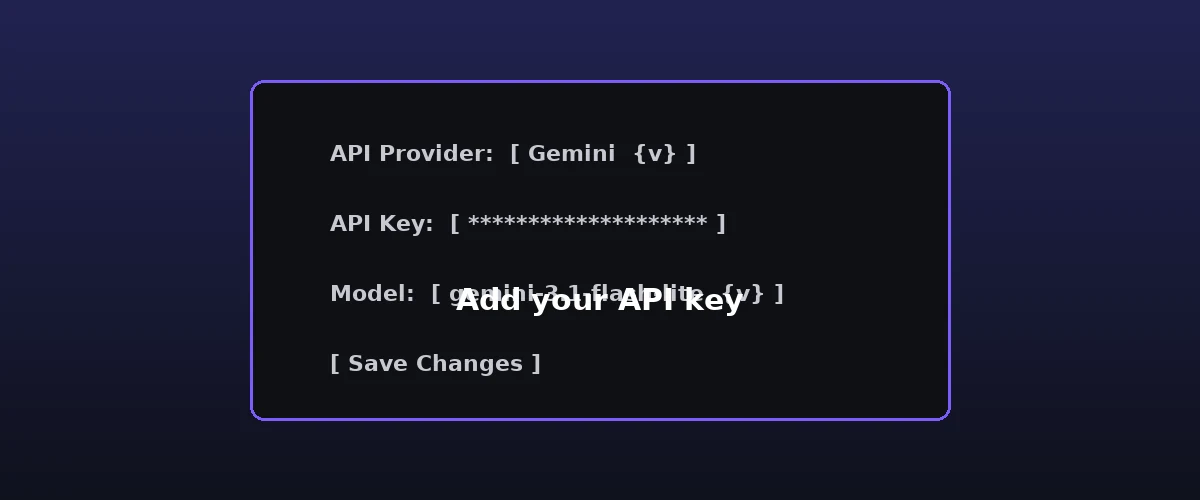
YakWP uses a model called BYOK, which means Bring Your Own Key. You sign up for a free or paid account with a model provider like Google Gemini, OpenAI, or OpenRouter, then paste your key into the plugin. The chatbot then uses that provider to generate answers.
This matters for two reasons. First, cost. Google’s free Gemini tier gives you 500 requests per day, which is plenty for a small bakery or a consultant. If you outgrow that, you pay the provider directly, not a middleman markup. Second, privacy. The conversation transcript and your product index stay in your own WordPress database. Only the prompt itself goes to the provider you chose.
So your customer’s chat history lives on your server, not on a third party’s cloud. That is a big deal for stores that handle personal data or just do not want to share everything with a SaaS company. You can read more about why BYOK and data ownership matter.
Chatbot WooCommerce: Can a WooCommerce Chatbot Increase Sales?
Yes, but not by magic. A chatbot helps in three concrete ways. First, it answers pre-sale questions instantly, so a visitor does not abandon the cart because they could not find the size chart. Second, it recommends products based on what the customer describes. Say a customer runs a two person cleaning company and wants eco friendly supplies. The bot can point them to the right category.
Third, it catches after-hours traffic. If someone visits at 11pm and asks about delivery times, the bot gives an answer right away. That person might otherwise leave and buy from a competitor the next morning. T

he bot does not close every sale, but it removes friction from the buying process.
One caution: the bot is only as good as your content. If your product descriptions are thin, the bot will struggle. Spend an hour writing clear answers to the top 20 questions you get, and the bot will handle most of those on its own.
How Do You Set Up a Chatbot for WooCommerce Fast?
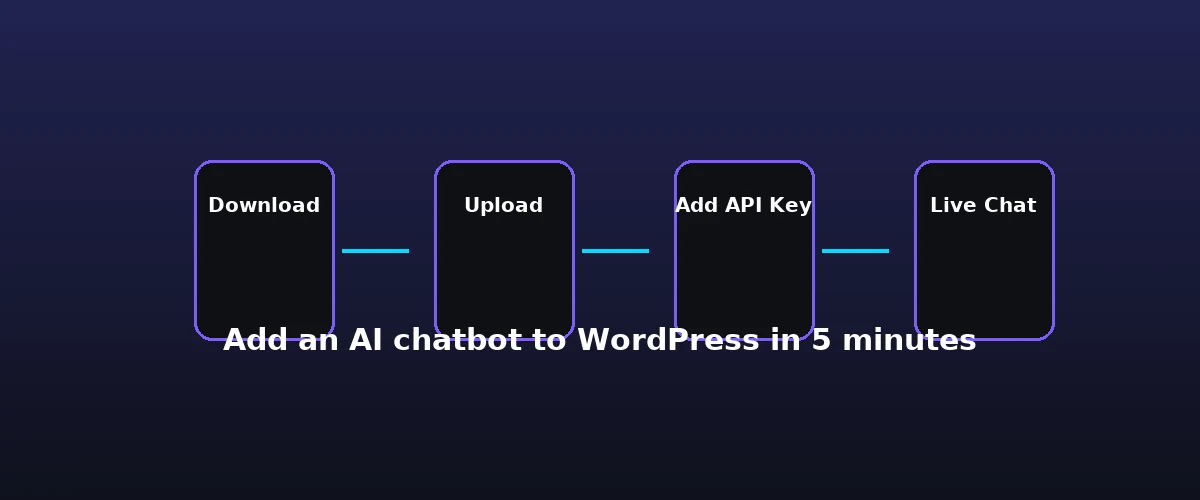
Setup takes about five minutes with YakWP. You install the plugin, create an account with a model provider, and paste your API key. Then you tell the bot which pages to read, like your shop page, your FAQ, and your shipping policy. The plugin indexes that content so the bot can search it later.
The bot uses something called semantic search, which means it understands meaning, not just keywords. If a customer types “when will my order arrive,” the bot knows that relates to your shipping page even if the exact words do not match. You can see how the bot finds answers in more detail.
After that, you place a chat widget on your site and test it with a few real questions. Most store owners tweak the tone of the answers in the first week. The full walkthrough is in this five minute setup guide.
Free vs Pro: What Do You Actually Miss?
The free tier of YakWP is not a crippled demo. It ships the full chatbot feature set, works on unlimited sites, and keeps conversations with retention. The only limits are that it shows a small “Powered by Yak” credit, and you cannot export conversations as CSV.
Pro removes that credit, which is called white-label, and adds custom widget CSS so you can match the chat bubble to your brand colors. Pro also adds CSV export, which is handy if you want to review chats in a spreadsheet, and priority support if something breaks. The one-time price is EUR 64 for a single site license, with volume options if you manage multiple stores.
For most small shops, the free tier is enough for months. Upgrade when you want the credit gone or you need the export. The free vs Pro breakdown covers every difference in plain language.
Which WooCommerce Chatbot Is Best for a Small Budget?
If your budget is zero, YakWP wins because the free tier has no site limit and no monthly cap on conversations. Tidio‘s free plan stops at 50 billable conversations per month, and Chatbase deletes your agents after 14 days of inactivity. Those are real constraints.
If you are willing to pay monthly, ChatBot.com starts at $19 per user per month for one AI agent and 10 AI resolutions. That is fine for a tiny store, but it scales fast. Intercom charges per outcome, which can be unpredictable if you get a busy month.
The honest advice is to start free. Install YakWP, connect a free Gemini key, and see if the bot handles your top questions. If it does, you have saved yourself a monthly bill. If you need more, the Pro upgrade is a one-time EUR 64, not a recurring fee. Compar

e that to $24.17 a month for Tidio, and the math is clear for a small operation.
What About the Big Names Like ManyChat?
ManyChat is popular for social media messaging, especially Instagram and Facebook. Its Pro tier starts around $15 per month, but that price is not verified on their site and can change. ManyChat is not built for WooCommerce product questions the way a dedicated chatbot plugin is. It is better for broadcast campaigns and simple flows.
If you want a bot that reads your product catalog and answers specific order questions, a WooCommerce focused plugin is a better fit. ManyChat can be a complement, but not a replacement, for on-site chat.
Chatbot WooCommerce: How to Choose the Best One
Start with the workflow you want to automate, then shortlist chatbot woocommerce that connect to it without middleware. The chatbot woocommerce that look best in a demo are not always the ones your team keeps using after the first month.
Score each option against three numbers: cost per resolved conversation, hours of setup, and who owns the conversation data. Those three numbers eliminate most of the chatbot woocommerce on a long list far faster than a feature matrix will.
To summarise, the chatbot woocommerce that fit your team are the ones you can operate without a dedicated engineer. Pick from the chatbot woocommerce above by matching one constraint first: budget, data ownership, or setup time. Whichever of the chatbot woocommerce you choose, budget an afternoon for testing real conversations before committing. Revisit your chatbot woocommerce shortlist every quarter, since pricing and model line-ups on this list change often.
Chatbot WooCommerce: What to Check Before You Install One
Most of the chatbot woocommerce shortlist on this page will answer questions. Fewer of them will help a shopper find the product they actually came for, and that is where a store earns its money. Before you install anything, check four things against your own store.
1. Does it read your catalog, or only your pages? A general website chatbot knows the pages you point it at. A store assistant also needs product titles, prices, stock status and categories. If you want shoppers to search in plain language instead of guessing keywords in your theme’s search box, the WooCommerce search integration is the part worth testing first — ask it for “a waterproof jacket under 100 euros” and see what comes back. That one test separates a chatbot woocommerce plugin that helps shoppers from one that only deflects them.
2. Does the setup fit into an afternoon? Install the plugin, connect a model API key, index your shop pages, then test with questions your customers really ask. If a tool needs a developer or a paid onboarding call before it says anything useful, it is the wrong tool for a small store.
3. Can you start at zero cost? YakWP is free on any number of WooCommerce stores; your own Gemini, OpenAI or OpenRouter key covers model usage. You pay once only if you later want white-label branding, CSV export or priority support.
4. What happens when the bot does not know? The correct behaviour is to say so and offer a handoff — an email capture or a contact link. A chatbot that invents a shipping time or a stock level costs you a customer, and you usually hear about it in a review rather than a support ticket. Test that failure path once, on the chatbot woocommerce option you are actually considering, before you commit.
Frequently Asked Questions
Can a WooCommerce chatbot replace customer support?
Not entirely, but it can handle the repetitive 80 percent. Order status, shipping times, return policies, and product specs are all fair game. When the bot hits a question it cannot answer, it should hand off to a human or collect an email. That reduces your workload without losing the personal touch.
How does a WooCommerce chatbot know about my products?
You point it at your product pages and other content, and it indexes that text. When a customer asks a question, the bot searches that index using semantic search to find the most relevant answer. It does not guess from general knowledge.
Is my customer chat data private?
With a self-hosted plugin like YakWP, the transcript and your content index stay in your WordPress database. The prompt is sent to the model provider you choose, like Google or OpenAI. So the data is not fully local, but it is not stored on a random SaaS platform either. You control the provider.
What if I have more than one WooCommerce store?
The free tier of YakWP works on any number of sites, so you can test it everywhere for $0. Pro is per site, but volume licenses cover 3, 5, 10, or 30 sites at a discount. The 3 site license is EUR 129, which is cheaper than buying three single licenses.
Do I need to be technical to set this up?
No. If you can install a WordPress plugin and copy paste a key, you can do it. The hardest part is choosing a model provider, and the free Gemini tier is a good start. The free Gemini tier limits are explained in plain terms.
Does a WooCommerce chatbot help shoppers find products?
It can, but only when it is connected to your catalog rather than just your pages. A product-aware assistant lets a shopper describe what they need in their own words and returns matching items with current prices and stock. That is a different job from answering policy questions, which is why the setup step matters: index the products, get the currency right, and test with the phrases customers actually type. A chatbot woocommerce setup that cannot answer a sizing or stock question will not earn its place.
How long does it take to set up a WooCommerce chatbot?
For a self-hosted plugin with your own model key, an afternoon is realistic: install it, connect the provider, let it index your store pages, then test. Hosted services switch on faster but add a monthly bill and keep the conversations on their servers. Budget extra time for testing either way — the first week of real questions tells you whether your store content is complete enough for the bot to answer well.
Where Do You Go From Here?
A chatbot for WooCommerce is not a luxury anymore. It is a practical way to answer questions at any hour, recommend products, and capture leads without hiring extra staff. The cost of entry is zero with YakWP, and the Pro upgrade is a one-time payment that will not creep up on your monthly bills.
Start with the free plugin, connect a free Gemini key, and let it index your shop pages. Test it with the questions your customers actually ask. If it works, you have saved yourself hours of repetitive replies. If you want the branding removed or CSV export later, the Pro upgrade is there when you are ready. The best time to add a chatbot to your WooCommerce store was yesterday. The second best time is right now.